Main menu

  • Home
  • Current Issue
  • Archive
  • Info for
    • Authors
    • Editorial Policies
    • Advertisers
    • Editorial Board
    • Special Issues
  • Journal Metrics
  • Other Publications
    • Anticancer Research
    • In Vivo
    • Cancer Diagnosis & Prognosis
  • More
    • IIAR
    • Conferences
  • About Us
    • General Policy
    • Contact
  • Other Publications
    • Cancer Genomics & Proteomics
    • Anticancer Research
    • In Vivo

User menu

  • Register
  • Subscribe
  • My alerts
  • Log in
  • My Cart

Search

  • Advanced search
Cancer Genomics & Proteomics
  • Other Publications
    • Cancer Genomics & Proteomics
    • Anticancer Research
    • In Vivo
  • Register
  • Subscribe
  • My alerts
  • Log in
  • My Cart
Cancer Genomics & Proteomics

Advanced Search

  • Home
  • Current Issue
  • Archive
  • Info for
    • Authors
    • Editorial Policies
    • Advertisers
    • Editorial Board
    • Special Issues
  • Journal Metrics
  • Other Publications
    • Anticancer Research
    • In Vivo
    • Cancer Diagnosis & Prognosis
  • More
    • IIAR
    • Conferences
  • About Us
    • General Policy
    • Contact
  • Visit iiar on Facebook
  • Follow us on Linkedin
Research ArticleArticle
Open Access

Small RNA Sequencing Identifies a Six-MicroRNA Signature Enabling Classification of Brain Metastases According to their Origin

IVANA ROSKOVA, MAREK VECERA, LENKA RADOVA, KAROLINA TRACHTOVA, FRANTISEK SIEGL, MARKETA HERMANOVA, MICHAL HENDRYCH, LEOS KREN, VACLAV VYBIHAL, HANA VALEKOVA, PETRA KASPAROVA, IVANA KOLOUSKOVA, TOMAS KAZDA, ONDREJ SLABY, RADIM JANCALEK, JIRI SANA and MARTIN SMRCKA
Cancer Genomics & Proteomics January 2023, 20 (1) 18-29; DOI: https://doi.org/10.21873/cgp.20361
IVANA ROSKOVA
1Department of Neurosurgery, University Hospital Brno, Brno, Czech Republic;
2Faculty of Medicine, Masaryk University, Brno, Czech Republic;
  • Find this author on Google Scholar
  • Find this author on PubMed
  • Search for this author on this site
MAREK VECERA
3Central European Institute of Technology, Masaryk University, Brno, Czech Republic;
  • Find this author on Google Scholar
  • Find this author on PubMed
  • Search for this author on this site
LENKA RADOVA
3Central European Institute of Technology, Masaryk University, Brno, Czech Republic;
  • Find this author on Google Scholar
  • Find this author on PubMed
  • Search for this author on this site
KAROLINA TRACHTOVA
3Central European Institute of Technology, Masaryk University, Brno, Czech Republic;
  • Find this author on Google Scholar
  • Find this author on PubMed
  • Search for this author on this site
FRANTISEK SIEGL
3Central European Institute of Technology, Masaryk University, Brno, Czech Republic;
  • Find this author on Google Scholar
  • Find this author on PubMed
  • Search for this author on this site
MARKETA HERMANOVA
2Faculty of Medicine, Masaryk University, Brno, Czech Republic;
4First Department of Pathology, St. Anne’s University Hospital, Brno, Czech Republic;
  • Find this author on Google Scholar
  • Find this author on PubMed
  • Search for this author on this site
MICHAL HENDRYCH
2Faculty of Medicine, Masaryk University, Brno, Czech Republic;
4First Department of Pathology, St. Anne’s University Hospital, Brno, Czech Republic;
  • Find this author on Google Scholar
  • Find this author on PubMed
  • Search for this author on this site
LEOS KREN
5Department of Pathology, University Hospital Brno, Brno, Czech Republic;
  • Find this author on Google Scholar
  • Find this author on PubMed
  • Search for this author on this site
VACLAV VYBIHAL
1Department of Neurosurgery, University Hospital Brno, Brno, Czech Republic;
  • Find this author on Google Scholar
  • Find this author on PubMed
  • Search for this author on this site
HANA VALEKOVA
2Faculty of Medicine, Masaryk University, Brno, Czech Republic;
6Department of Neurosurgery, St. Anne’s University Hospital, Brno, Czech Republic;
  • Find this author on Google Scholar
  • Find this author on PubMed
  • Search for this author on this site
PETRA KASPAROVA
7The Fingerland Department of Pathology, University Hospital Hradec Kralove, Hradec Kralove, Czech Republic;
  • Find this author on Google Scholar
  • Find this author on PubMed
  • Search for this author on this site
IVANA KOLOUSKOVA
2Faculty of Medicine, Masaryk University, Brno, Czech Republic;
  • Find this author on Google Scholar
  • Find this author on PubMed
  • Search for this author on this site
TOMAS KAZDA
2Faculty of Medicine, Masaryk University, Brno, Czech Republic;
8Department of Radiation Oncology, Masaryk Memorial Cancer Institute, Brno, Czech Republic;
  • Find this author on Google Scholar
  • Find this author on PubMed
  • Search for this author on this site
ONDREJ SLABY
3Central European Institute of Technology, Masaryk University, Brno, Czech Republic;
9Department of Biology, Faculty of Medicine, Masaryk University, Brno, Czech Republic;
  • Find this author on Google Scholar
  • Find this author on PubMed
  • Search for this author on this site
RADIM JANCALEK
2Faculty of Medicine, Masaryk University, Brno, Czech Republic;
6Department of Neurosurgery, St. Anne’s University Hospital, Brno, Czech Republic;
  • Find this author on Google Scholar
  • Find this author on PubMed
  • Search for this author on this site
JIRI SANA
3Central European Institute of Technology, Masaryk University, Brno, Czech Republic;
10Department of Comprehensive Cancer Care, Masaryk Memorial Cancer Institute, Brno, Czech Republic
  • Find this author on Google Scholar
  • Find this author on PubMed
  • Search for this author on this site
  • For correspondence: sana.jiri{at}gmail.com
MARTIN SMRCKA
1Department of Neurosurgery, University Hospital Brno, Brno, Czech Republic;
2Faculty of Medicine, Masaryk University, Brno, Czech Republic;
  • Find this author on Google Scholar
  • Find this author on PubMed
  • Search for this author on this site
  • For correspondence: smrcka.martin{at}fnbrno.cz
  • Article
  • Figures & Data
  • Info & Metrics
  • PDF
Loading

Article Figures & Data

Figures

  • Figure 1.
    • Download figure
    • Open in new tab
    • Download powerpoint
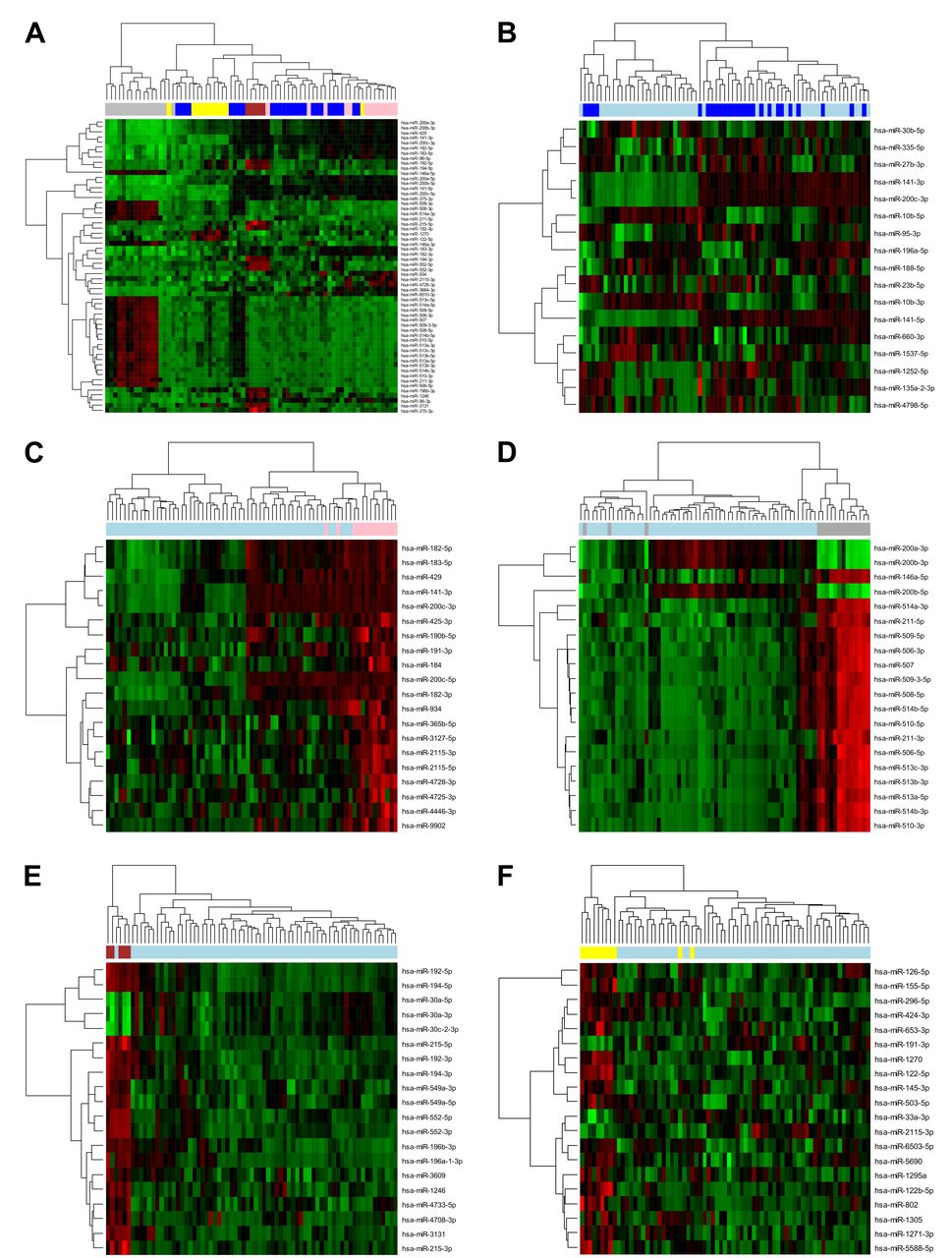
    Figure 1.

    Results from differential analysis of miRNA expression assessed by small RNA sequencing in 71 samples of brain metastases (BM) derived from 5 tumor types, including lung carcinomas (dark blue), breast carcinomas (pink), melanomas (gray), colorectal carcinomas (dark red), and renal cell carcinomas (yellow). (A) The miRNA expression profiles in the 5 groups of BMs were compared, resulting in the identification of 58 significantly differentially expressed miRNAs with Benjamini-Hochberg adjusted p-Value smaller than 0.000001. The expression profiles of these miRNAs were visualized in a heatmap with dendrogram. Furthermore, each group was also compared with another group comprised of other BMs. The heatmaps with dendrogram show the results of hierarchical clustering based on the expression of (B) 17 differentially expressed miRNAs (adjusted p-Value <0.05) in BMs derived from lung carcinomas (dark blue) vs. other BMs (light blue), and the 20 most significantly differentially expressed miRNAs in (C) BMs derived from breast carcinomas (pink) vs. other BMs (light blue) (adjusted p-Value ≤0.0017), (D) melanoma-derived BMs (gray) vs. other BMs (light blue) (adjusted p-Value <0.0001), (E) BMs derived from colorectal carcinomas (dark red) vs. other BMs (light blue) (adjusted p-Value ≤0.0002), and (F) BMs derived from renal cell carcinomas (yellow) vs. other BMs (light blue) (adjusted p-Value ≤0.0135). The green-black-red spectrum represents miRNA expression in samples from low (green) to high expression (red).

  • Figure 2.
    • Download figure
    • Open in new tab
    • Download powerpoint
    Figure 2.

    Results from the classifier algorithm and the differential analysis based on the miRNA expression assessed by small RNA sequencing. (A) The classifier algorithm is based on the expression of 6 miRNAs (hsa-miR-141-3p, hsa-miR-141-5p, hsa-miR-146a-5p, hsa-miR-194-5p, hsa-miR-200b-3p, hsa-miR-365b-5p) in 71 samples of BMs derived from lung carcinomas (BML), breast carcinomas (BMB), melanomas (BMM), colorectal carcinomas (BMC), and renal cell carcinomas (BMR). The real BM origin is represented by columns and the classifier prediction by rows. The classifier correctly identified the origin of 91.5% of samples which are highlighted in green. Incorrectly classified samples are highlighted in yellow. The corresponding sensitivity, specificity and 95% confidence interval (CI) values for each group of BMs are shown in the bottom part. (B) The hierarchical clustering analysis based on the expression of the 6 miRNAs in 71 samples of BMs derived from lung carcinomas (dark blue), breast carcinomas (pink), melanomas (gray), colorectal carcinomas (dark red), and renal cell carcinomas (yellow) was visualized in a heatmap with dendrogram. The green-black-red spectrum represents miRNA expression in samples from low (green) to high expression (red).

  • Figure 3.
    • Download figure
    • Open in new tab
    • Download powerpoint
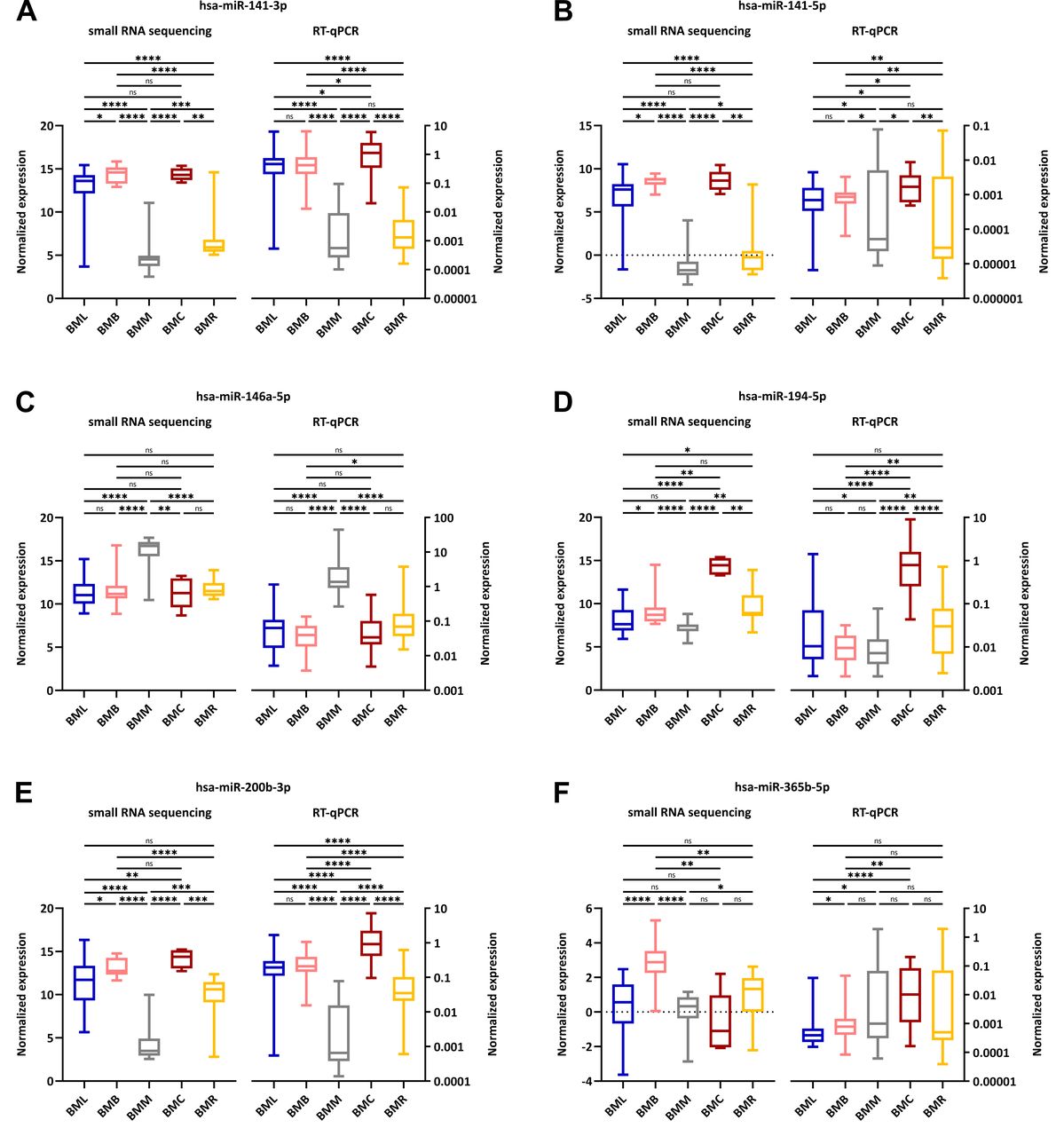
    Figure 3.

    Comparison of the expression patterns of the 6 miRNAs; namely (A) hsa-miR-141-3p, (B) hsa-miR-141-5p, (C) hsa-miR-146a-5p, (D) hsa-miR-194-5p, (E) hsa-miR-200b-3p and (F) hsa-miR-365b-5p. The expression was analyzed by small RNA sequencing and RT-qPCR in 71 native tissue samples and 119 formalin-fixed paraffin-embedded tissue samples, respectively, which were derived from lung carcinomas (BML, blue), breast carcinomas (BMB, pink), melanomas (BMM, gray), colorectal carcinomas (BMC, dark red), and renal cell carcinomas (BMR, yellow). Median values of normalized expression were compared using the non-parametric Mann-Whitney U-test. The statistical significance of the results is denoted by ns (not significant; p>0.05), *p<0.05, **p<0.01, ***p<0.001 and ****p<0.0001.

  • Figure 4.
    • Download figure
    • Open in new tab
    • Download powerpoint
    Figure 4.

    Results from the classifier algorithm, which is based on the expression of 6 miRNAs (hsa-miR-141-3p, hsa-miR-141-5p, hsa-miR-146a-5p, hsa-miR-194-5p, hsa-miR-200b-3p, hsa-miR-365b-5p) assessed by RT-qPCR in 119 formalin-fixed paraffin-embedded tissue samples of brain metastases (BM). The real BM origin is represented by columns and the classifier prediction by rows. The classifier correctly identified the origin of 77.3% of samples which are highlighted in green. Incorrectly classified samples are highlighted in yellow. The corresponding sensitivity, specificity and 95% confidence interval (CI) values for each group of BMs are shown in the bottom part.

PreviousNext
Back to top

In this issue

Cancer Genomics - Proteomics: 20 (1)
Cancer Genomics & Proteomics
Vol. 20, Issue 1
January-February 2023
  • Table of Contents
  • Table of Contents (PDF)
  • About the Cover
  • Index by author
  • Back Matter (PDF)
  • Ed Board (PDF)
  • Front Matter (PDF)
Print
Download PDF
Article Alerts
Sign In to Email Alerts with your Email Address
Email Article

Thank you for your interest in spreading the word on Cancer Genomics & Proteomics.

NOTE: We only request your email address so that the person you are recommending the page to knows that you wanted them to see it, and that it is not junk mail. We do not capture any email address.

Enter multiple addresses on separate lines or separate them with commas.
Small RNA Sequencing Identifies a Six-MicroRNA Signature Enabling Classification of Brain Metastases According to their Origin
(Your Name) has sent you a message from Cancer Genomics & Proteomics
(Your Name) thought you would like to see the Cancer Genomics & Proteomics web site.
CAPTCHA
This question is for testing whether or not you are a human visitor and to prevent automated spam submissions.
1 + 0 =
Solve this simple math problem and enter the result. E.g. for 1+3, enter 4.
Citation Tools
Small RNA Sequencing Identifies a Six-MicroRNA Signature Enabling Classification of Brain Metastases According to their Origin
IVANA ROSKOVA, MAREK VECERA, LENKA RADOVA, KAROLINA TRACHTOVA, FRANTISEK SIEGL, MARKETA HERMANOVA, MICHAL HENDRYCH, LEOS KREN, VACLAV VYBIHAL, HANA VALEKOVA, PETRA KASPAROVA, IVANA KOLOUSKOVA, TOMAS KAZDA, ONDREJ SLABY, RADIM JANCALEK, JIRI SANA, MARTIN SMRCKA
Cancer Genomics & Proteomics Jan 2023, 20 (1) 18-29; DOI: 10.21873/cgp.20361

Citation Manager Formats

  • BibTeX
  • Bookends
  • EasyBib
  • EndNote (tagged)
  • EndNote 8 (xml)
  • Medlars
  • Mendeley
  • Papers
  • RefWorks Tagged
  • Ref Manager
  • RIS
  • Zotero
Reprints and Permissions
Share
Small RNA Sequencing Identifies a Six-MicroRNA Signature Enabling Classification of Brain Metastases According to their Origin
IVANA ROSKOVA, MAREK VECERA, LENKA RADOVA, KAROLINA TRACHTOVA, FRANTISEK SIEGL, MARKETA HERMANOVA, MICHAL HENDRYCH, LEOS KREN, VACLAV VYBIHAL, HANA VALEKOVA, PETRA KASPAROVA, IVANA KOLOUSKOVA, TOMAS KAZDA, ONDREJ SLABY, RADIM JANCALEK, JIRI SANA, MARTIN SMRCKA
Cancer Genomics & Proteomics Jan 2023, 20 (1) 18-29; DOI: 10.21873/cgp.20361
Twitter logo Facebook logo Mendeley logo
  • Tweet Widget
  • Facebook Like
  • Google Plus One

Jump to section

  • Article
    • Abstract
    • Materials and Methods
    • Results
    • Discussion
    • Conclusion
    • Acknowledgements
    • Footnotes
    • References
  • Figures & Data
  • Info & Metrics
  • PDF

Related Articles

Cited By...

  • Circulating Serum piRNAs as Diagnostic and Prognostic Tools for Clear Cell Renal Cell Carcinoma
  • Google Scholar

More in this TOC Section

  • Recurrent 8q11-13 Aberrations Leading to PLAG1 Rearrangements, Including Novel Chimeras HNRNPA2B1::PLAG1 and SDCBP::PLAG1, in Lipomatous Tumors
  • Receptor for Hyaluronic Acid-mediated Motility (RHAMM) Is Associated With Prostate Cancer Migration and Poor Prognosis
  • Oncogenes and Methionine Addiction of Cancer: Role of c-MYC
Show more Article

Keywords

  • Brain metastases
  • microRNA
  • small RNA sequencing
  • classifier
  • diagnosis
Cancer & Genome Proteomics

© 2026 Cancer Genomics & Proteomics

Powered by HighWire