Main menu

  • Home
  • Current Issue
  • Archive
  • Info for
    • Authors
    • Editorial Policies
    • Advertisers
    • Editorial Board
    • Special Issues
  • Journal Metrics
  • Other Publications
    • Anticancer Research
    • In Vivo
    • Cancer Diagnosis & Prognosis
  • More
    • IIAR
    • Conferences
  • About Us
    • General Policy
    • Contact
  • Other Publications
    • Cancer Genomics & Proteomics
    • Anticancer Research
    • In Vivo

User menu

  • Register
  • Subscribe
  • My alerts
  • Log in
  • My Cart

Search

  • Advanced search
Cancer Genomics & Proteomics
  • Other Publications
    • Cancer Genomics & Proteomics
    • Anticancer Research
    • In Vivo
  • Register
  • Subscribe
  • My alerts
  • Log in
  • My Cart
Cancer Genomics & Proteomics

Advanced Search

  • Home
  • Current Issue
  • Archive
  • Info for
    • Authors
    • Editorial Policies
    • Advertisers
    • Editorial Board
    • Special Issues
  • Journal Metrics
  • Other Publications
    • Anticancer Research
    • In Vivo
    • Cancer Diagnosis & Prognosis
  • More
    • IIAR
    • Conferences
  • About Us
    • General Policy
    • Contact
  • Visit iiar on Facebook
  • Follow us on Linkedin
Research ArticleArticle

Fusion of the Paired Box 3 (PAX3) and Myocardin (MYOCD) Genes in Pediatric Rhabdomyosarcoma

IOANNIS PANAGOPOULOS, LUDMILA GORUNOVA, KRISTIN ANDERSEN, MARIUS LUND-IVERSEN, SVETLANA TAFJORD, FRANCESCA MICCI and SVERRE HEIM
Cancer Genomics & Proteomics November 2021, 18 (6) 723-734; DOI: https://doi.org/10.21873/cgp.20293
IOANNIS PANAGOPOULOS
1Section for Cancer Cytogenetics, Institute for Cancer Genetics and Informatics, The Norwegian Radium Hospital, Oslo University Hospital, Oslo, Norway;
  • Find this author on Google Scholar
  • Find this author on PubMed
  • Search for this author on this site
  • For correspondence: ioannis.panagopoulos{at}rr-research.no
LUDMILA GORUNOVA
1Section for Cancer Cytogenetics, Institute for Cancer Genetics and Informatics, The Norwegian Radium Hospital, Oslo University Hospital, Oslo, Norway;
  • Find this author on Google Scholar
  • Find this author on PubMed
  • Search for this author on this site
KRISTIN ANDERSEN
1Section for Cancer Cytogenetics, Institute for Cancer Genetics and Informatics, The Norwegian Radium Hospital, Oslo University Hospital, Oslo, Norway;
  • Find this author on Google Scholar
  • Find this author on PubMed
  • Search for this author on this site
MARIUS LUND-IVERSEN
2Department of Pathology, The Norwegian Radium Hospital, Oslo University Hospital, Oslo, Norway;
  • Find this author on Google Scholar
  • Find this author on PubMed
  • Search for this author on this site
SVETLANA TAFJORD
2Department of Pathology, The Norwegian Radium Hospital, Oslo University Hospital, Oslo, Norway;
  • Find this author on Google Scholar
  • Find this author on PubMed
  • Search for this author on this site
FRANCESCA MICCI
1Section for Cancer Cytogenetics, Institute for Cancer Genetics and Informatics, The Norwegian Radium Hospital, Oslo University Hospital, Oslo, Norway;
  • Find this author on Google Scholar
  • Find this author on PubMed
  • Search for this author on this site
SVERRE HEIM
1Section for Cancer Cytogenetics, Institute for Cancer Genetics and Informatics, The Norwegian Radium Hospital, Oslo University Hospital, Oslo, Norway;
3Institute of Clinical Medicine, Faculty of Medicine, University of Oslo, Oslo, Norway
  • Find this author on Google Scholar
  • Find this author on PubMed
  • Search for this author on this site
  • Article
  • Figures & Data
  • Info & Metrics
  • PDF
Loading

Article Figures & Data

Figures

  • Tables
  • Figure 1.
    • Download figure
    • Open in new tab
    • Download powerpoint
    Figure 1.

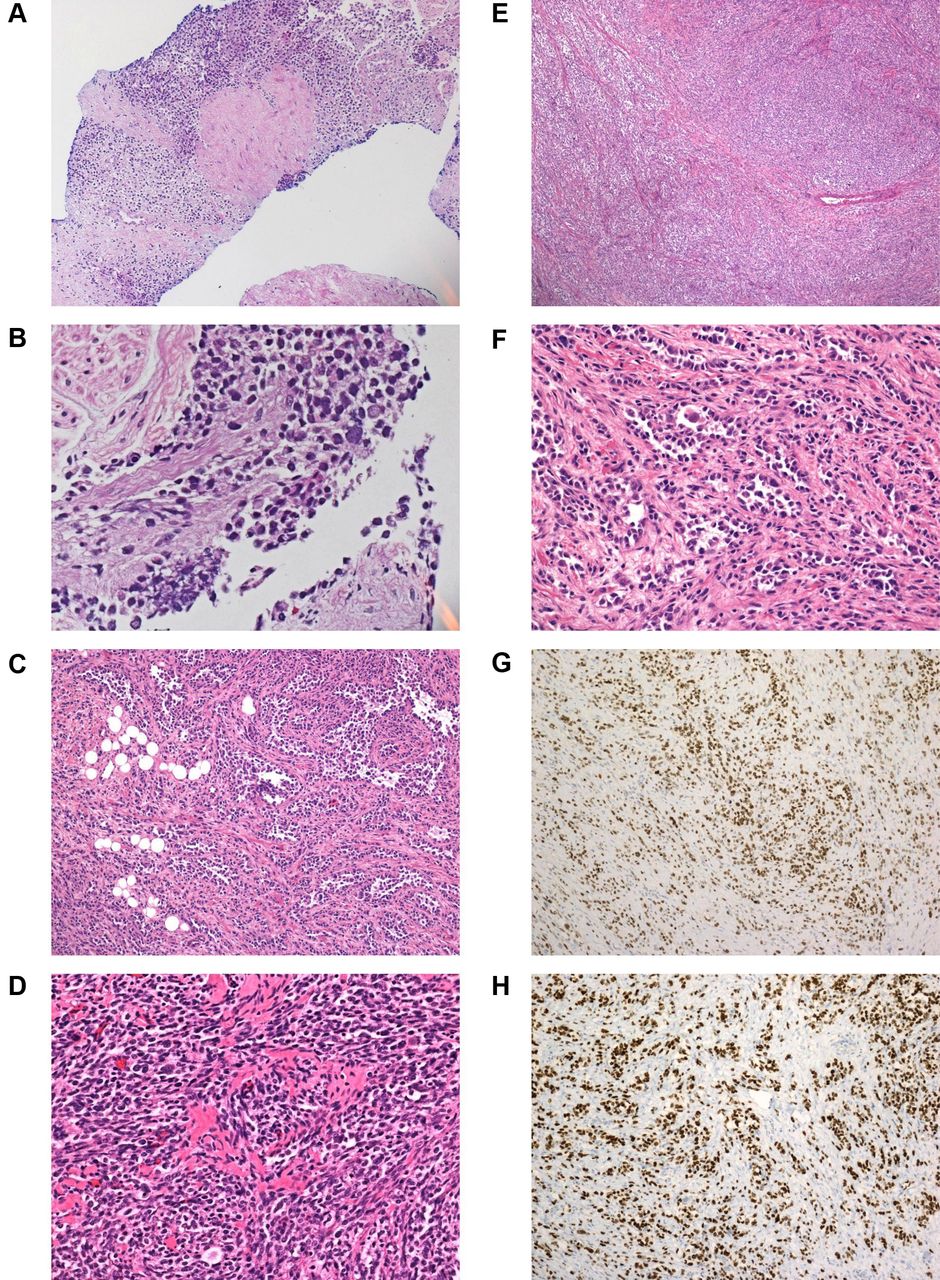
    Microscopic examination of the pediatric rhabdomyosarcoma. (A, B, and C) Tumor with alveolar growth pattern showing loosely arranged tumor cells surrounded by fibrous septa. (D) Tumor with spindle cell pattern. (E) Tumor with mixed growth pattern. (F) Tumor in nests. (G) Transcription factor AP-2 beta showed diffuse and strong expression in tumor nuclei. (H) Myogenin showed strong positive staining in nearly 100% of tumor nuclei.

  • Figure 2.
    • Download figure
    • Open in new tab
    • Download powerpoint
    Figure 2.

    Cytogenetic examination of the pediatric rhabdomyosarcoma. Representative karyogram showing the abnormal karyotype 48,add(2)(q11),+del(2)(q35),add(3)(q?25),−7,del(8)(p21),−15,add(17)(p11),+20,+der(?)t(?;15)(?;q15),+mar.

  • Figure 3.
    • Download figure
    • Open in new tab
    • Download powerpoint
    Figure 3.

    Fluorescence in situ hybridization (FISH) analysis of the pediatric rhabdomyosarcoma using a commercial PAX3 breakapart probe. (A) Diagram showing the proximal (red) and distal (green) parts of the PAX3 breakapart probe. The neighbor gene sphingosine-1-phosphate phosphatase 2 (SGPP2) and the genetic markers D2S102, D2S2599, D2S313, and D2S2300 are also shown. (B) FISH on interphase nucleus with the PAX3 breakapart probe.

  • Figure 4.
    • Download figure
    • Open in new tab
    • Download powerpoint
    Figure 4.

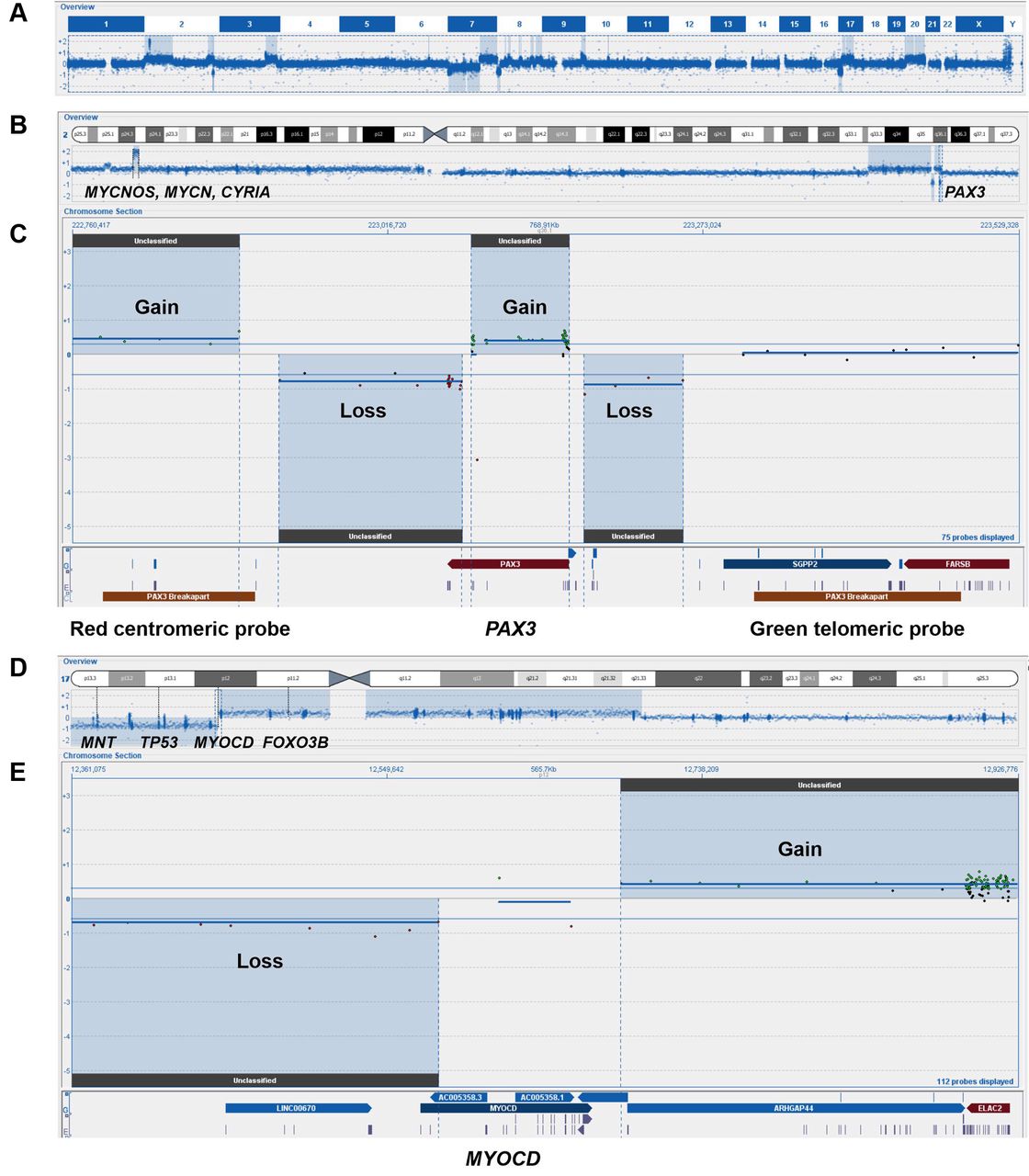
    Array comparative genomic hybridization (aCGH) analysis of the pediatric rhabdomyosarcoma. (A) Whole genome aCGH showing trisomy for chromosome 20 and gains as well as losses from parts of chromosomes 2, 3, 6, 7, 8, 9, 10, 17, and 19. (B) Regions of chromosome 2 with gains and losses. The positions of the genes MYCNOS, MYCN, CYRIA, and PAX3 are shown. (C) The region around PAX3 showing both gains and losses. The position of the red centromeric and the green telomeric probes of the FISH PAX3 breakapart probe are also shown. The genomic area of PAX3 encompassing exons 1 to 7 is gained whereas the PAX3 area encompassing exons 8 to 10 is heterozygously lost. The FISH red centromeric probe maps to an area which has an extra copy (gain). (D) Regions of chromosome 17 with gain and loss. The positions of the genes MNT, TP53, MYOCD, and FOXO3B are shown. (E) The region around the MYOCD showing loss of a copy at the telomeric area (loss) and gain of a copy near the centromere. The few aCGH probes for MYOCD are inadequate to draw any certain conclusion as to possible copy number change of MYOCD.

  • Figure 5.
    • Download figure
    • Open in new tab
    • Download powerpoint
    Figure 5.

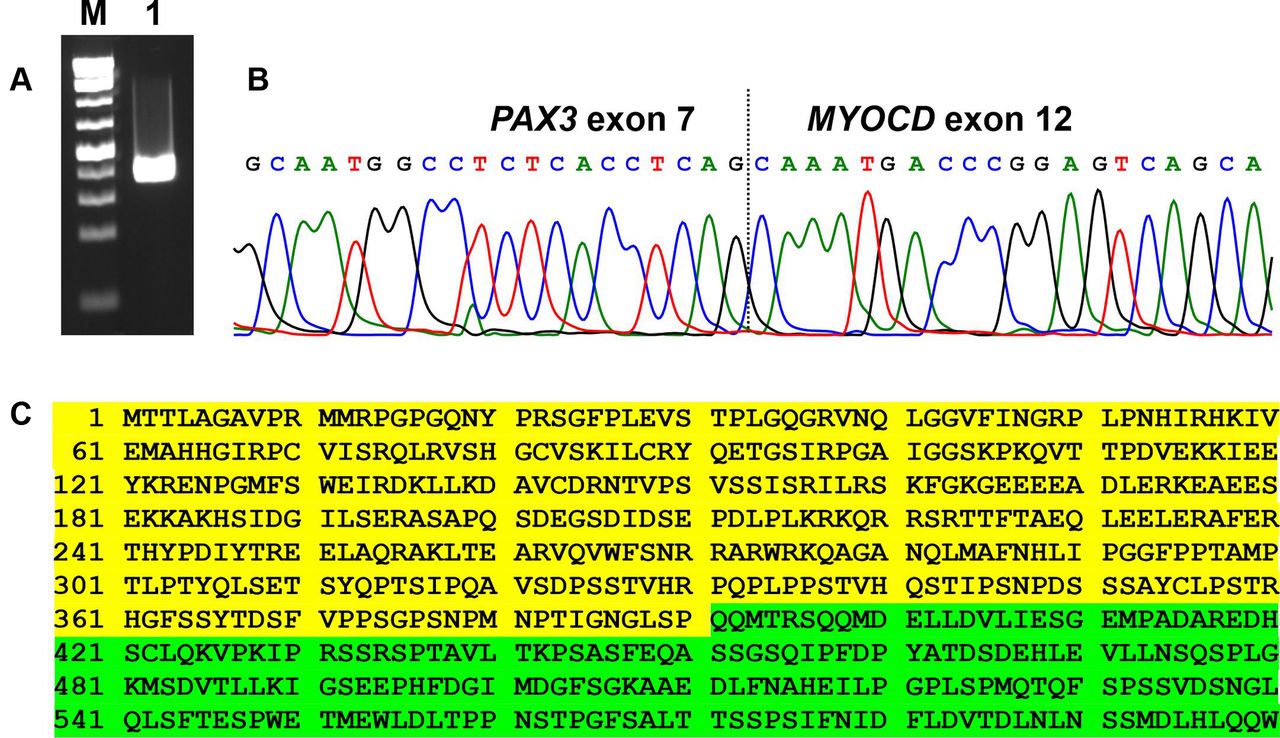
    Molecular genetic analyses of the pediatric rhabdomyosarcoma. (A) Gel electrophoresis showing the amplified PAX3-MYOCD cDNA fragment with nested PCR using the primer combination PAX3-1374F1/MYOCD-2664R1 (lane 1). M: GeneRuler 1 Kb Plus DNA ladder (ThermoFisher Scientific). (B) Partial sequence chromatograms of the cDNA amplified fragment showing the junction position of the PAX3 and MYOCD genes (vertical dotted line). In the PAX3-MYOCD fusion transcript, exon 7 of PAX3 (nt 1556 in reference sequence NM_181457.4) was fused in frame with exon 12 of MYOCD (nt 2487 in reference sequence NM_153604.3). (C) The 600 amino acid (aa) residues of the PAX3-MYOCD protein is composed of the first 390 aa (in yellow) from PAX3 (1-390 from NP_852122.1) and the last 210 aa (in green) from MYOCD which contains the transactivation domain of MYOCD (729-938 from NP_705832.1).

Tables

  • Figures
  • Table I.
  • Table II.
PreviousNext
Back to top

In this issue

Cancer Genomics & Proteomics
Vol. 18, Issue 6
November-December 2021
  • Table of Contents
  • Table of Contents (PDF)
  • Index by author
  • Back Matter (PDF)
  • Ed Board (PDF)
  • Front Matter (PDF)
Print
Download PDF
Article Alerts
Sign In to Email Alerts with your Email Address
Email Article

Thank you for your interest in spreading the word on Cancer Genomics & Proteomics.

NOTE: We only request your email address so that the person you are recommending the page to knows that you wanted them to see it, and that it is not junk mail. We do not capture any email address.

Enter multiple addresses on separate lines or separate them with commas.
Fusion of the Paired Box 3 (PAX3) and Myocardin (MYOCD) Genes in Pediatric Rhabdomyosarcoma
(Your Name) has sent you a message from Cancer Genomics & Proteomics
(Your Name) thought you would like to see the Cancer Genomics & Proteomics web site.
CAPTCHA
This question is for testing whether or not you are a human visitor and to prevent automated spam submissions.
2 + 15 =
Solve this simple math problem and enter the result. E.g. for 1+3, enter 4.
Citation Tools
Fusion of the Paired Box 3 (PAX3) and Myocardin (MYOCD) Genes in Pediatric Rhabdomyosarcoma
IOANNIS PANAGOPOULOS, LUDMILA GORUNOVA, KRISTIN ANDERSEN, MARIUS LUND-IVERSEN, SVETLANA TAFJORD, FRANCESCA MICCI, SVERRE HEIM
Cancer Genomics & Proteomics Nov 2021, 18 (6) 723-734; DOI: 10.21873/cgp.20293

Citation Manager Formats

  • BibTeX
  • Bookends
  • EasyBib
  • EndNote (tagged)
  • EndNote 8 (xml)
  • Medlars
  • Mendeley
  • Papers
  • RefWorks Tagged
  • Ref Manager
  • RIS
  • Zotero
Reprints and Permissions
Share
Fusion of the Paired Box 3 (PAX3) and Myocardin (MYOCD) Genes in Pediatric Rhabdomyosarcoma
IOANNIS PANAGOPOULOS, LUDMILA GORUNOVA, KRISTIN ANDERSEN, MARIUS LUND-IVERSEN, SVETLANA TAFJORD, FRANCESCA MICCI, SVERRE HEIM
Cancer Genomics & Proteomics Nov 2021, 18 (6) 723-734; DOI: 10.21873/cgp.20293
Twitter logo Facebook logo Mendeley logo
  • Tweet Widget
  • Facebook Like
  • Google Plus One

Jump to section

  • Article
    • Abstract
    • Materials and Methods
    • Results
    • Discussion
    • Acknowledgements
    • Footnotes
    • References
  • Figures & Data
  • Info & Metrics
  • PDF

Related Articles

Cited By...

  • Thioredoxin Reductase Inhibitor Suppresses the Local Progression of Rhabdomyosarcoma With PDX Models
  • Google Scholar

More in this TOC Section

  • Myb Repression Mediates Stat5b-knockdown-induced Apoptosis and Inhibits Proliferation of Glioblastoma Stem Cells
  • Dynamic Changes in Peripheral Systemic Immunity Markers During Chemotherapy in HER2-negative Advanced Breast Cancer
  • Recurrent 8q11-13 Aberrations Leading to PLAG1 Rearrangements, Including Novel Chimeras HNRNPA2B1::PLAG1 and SDCBP::PLAG1, in Lipomatous Tumors
Show more Article

Keywords

  • Pediatric
  • Rhabdomyosarcoma
  • chromosome translocation
  • PAX3
  • MYOCD
  • PAX3-MYOCD fusion gene
Cancer & Genome Proteomics

© 2026 Cancer Genomics & Proteomics

Powered by HighWire