Main menu

  • Home
  • Current Issue
  • Archive
  • Info for
    • Authors
    • Editorial Policies
    • Advertisers
    • Editorial Board
    • Special Issues
  • Journal Metrics
  • Other Publications
    • Anticancer Research
    • In Vivo
    • Cancer Diagnosis & Prognosis
  • More
    • IIAR
    • Conferences
  • About Us
    • General Policy
    • Contact
  • Other Publications
    • Cancer Genomics & Proteomics
    • Anticancer Research
    • In Vivo

User menu

  • Register
  • Subscribe
  • My alerts
  • Log in
  • My Cart

Search

  • Advanced search
Cancer Genomics & Proteomics
  • Other Publications
    • Cancer Genomics & Proteomics
    • Anticancer Research
    • In Vivo
  • Register
  • Subscribe
  • My alerts
  • Log in
  • My Cart
Cancer Genomics & Proteomics

Advanced Search

  • Home
  • Current Issue
  • Archive
  • Info for
    • Authors
    • Editorial Policies
    • Advertisers
    • Editorial Board
    • Special Issues
  • Journal Metrics
  • Other Publications
    • Anticancer Research
    • In Vivo
    • Cancer Diagnosis & Prognosis
  • More
    • IIAR
    • Conferences
  • About Us
    • General Policy
    • Contact
  • Visit iiar on Facebook
  • Follow us on Linkedin
Research ArticleArticle

CRY1 Regulates Chemoresistance in Association With NANOG by Inhibiting Apoptosis via STAT3 Pathway in Patients With Cervical Cancer

GWAN HEE HAN, JULIE KIM, HEE YUN, HANBYOUL CHO, JOON-YONG CHUNG, JAE-HOON KIM and STEPHEN M. HEWITT
Cancer Genomics & Proteomics November 2021, 18 (6) 699-713; DOI: https://doi.org/10.21873/cgp.20291
GWAN HEE HAN
1Department of Obstetrics and Gynecology, Kyung Hee University Hospital at Gangdong, Seoul, Republic of Korea;
2Yonsei University Graduate School, Seoul, Republic of Korea;
  • Find this author on Google Scholar
  • Find this author on PubMed
  • Search for this author on this site
JULIE KIM
3Weill Cornell Medical College, New York, NY, U.S.A.;
  • Find this author on Google Scholar
  • Find this author on PubMed
  • Search for this author on this site
HEE YUN
4Department of Obstetrics and Gynecology, Gangnam Severance Hospital, Yonsei University College of Medicine, Seoul, Republic of Korea;
  • Find this author on Google Scholar
  • Find this author on PubMed
  • Search for this author on this site
HANBYOUL CHO
5Department of Obstetrics and Gynecology, Yonsei University College of Medicine, Seoul, Republic of Korea;
6Institute of Women’s Life Medical Science, Yonsei University College of Medicine, Seoul, Republic of Korea;
7Laboratory of Pathology, Center for Cancer Research, National Cancer Institute, National Institutes of Health, Bethesda, MD, U.S.A.
  • Find this author on Google Scholar
  • Find this author on PubMed
  • Search for this author on this site
  • For correspondence: hanbyoul{at}yuhs.ac
JOON-YONG CHUNG
7Laboratory of Pathology, Center for Cancer Research, National Cancer Institute, National Institutes of Health, Bethesda, MD, U.S.A.
  • Find this author on Google Scholar
  • Find this author on PubMed
  • Search for this author on this site
JAE-HOON KIM
5Department of Obstetrics and Gynecology, Yonsei University College of Medicine, Seoul, Republic of Korea;
6Institute of Women’s Life Medical Science, Yonsei University College of Medicine, Seoul, Republic of Korea;
  • Find this author on Google Scholar
  • Find this author on PubMed
  • Search for this author on this site
STEPHEN M. HEWITT
7Laboratory of Pathology, Center for Cancer Research, National Cancer Institute, National Institutes of Health, Bethesda, MD, U.S.A.
  • Find this author on Google Scholar
  • Find this author on PubMed
  • Search for this author on this site
  • Article
  • Figures & Data
  • Info & Metrics
  • PDF
Loading

Article Figures & Data

Figures

  • Tables
  • Figure 1.
    • Download figure
    • Open in new tab
    • Download powerpoint
    Figure 1.
    • Download figure
    • Open in new tab
    • Download powerpoint
    Figure 1.

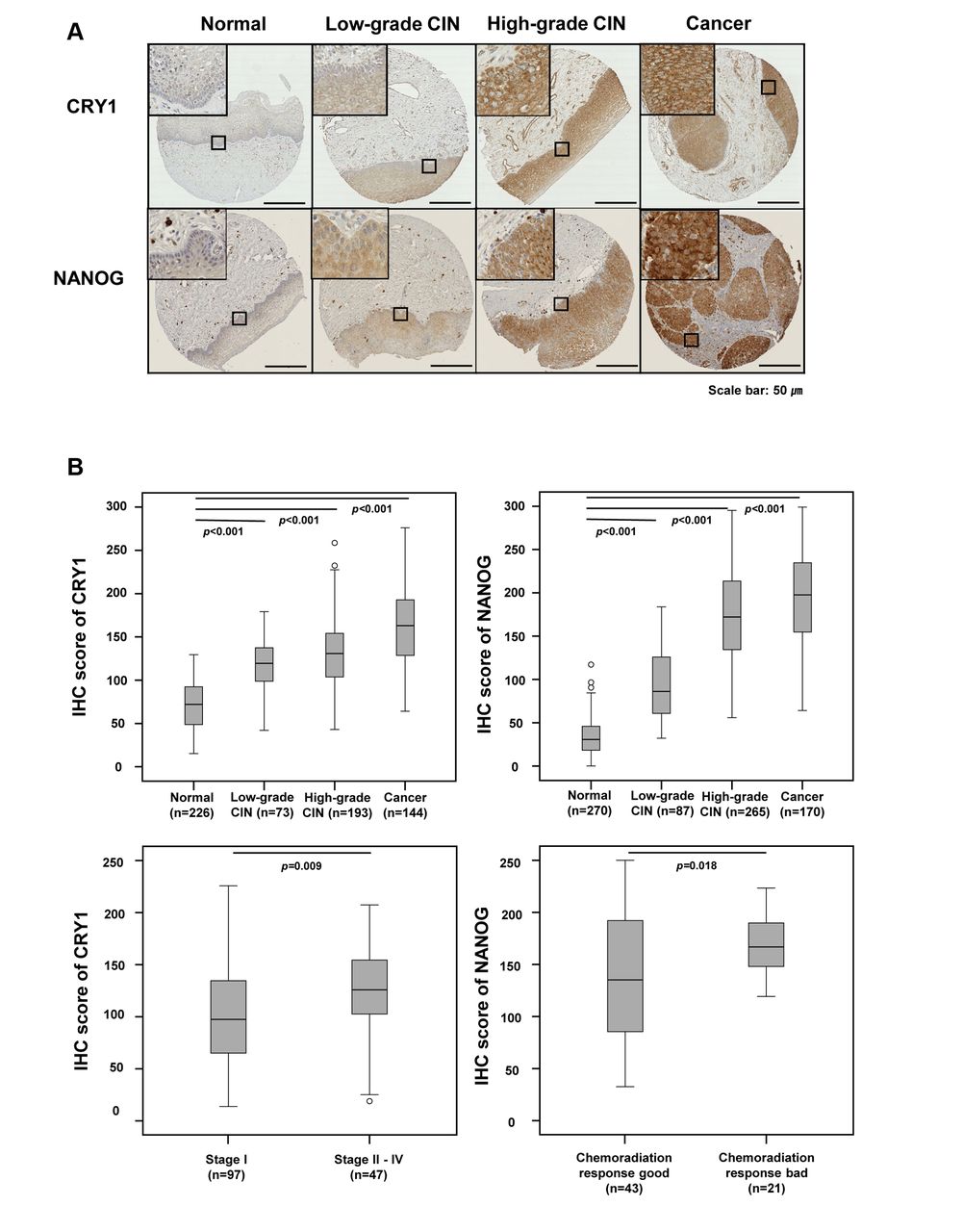
    CRY1 and NANOG expression in normal cervical epithelial, low-grade cervical intraepithelial neoplasia (CIN), high-grade CIN, and cervical cancer tissues. (A) Representative immunohistochemical images of CRY1 and NANOG in normal cervical epithelial, low-grade CIN, high-grade CIN, and cervical cancer tissues. Scale bar: 50 μm (B) Comparison of IHC staining score for CRY1 in normal cervical epithelial, low-grade CIN, high-grade CIN, and cervical cancer tissues and between stage I and stages II-IV in cervical cancer tissues. Comparison of IHC scoring for NANOG in normal cervical epithelial, low-grade CIN, high-grade CIN, and cervical cancer tissues and between good and poor chemoradiation response in cervical cancer patients. (C) Combined over-expression of CRY1 and NANOG showed more predictive value for the response to chemoradiation treatment over single gene expression of CRY1 or NANOG.

  • Figure 2.
    • Download figure
    • Open in new tab
    • Download powerpoint
    Figure 2.

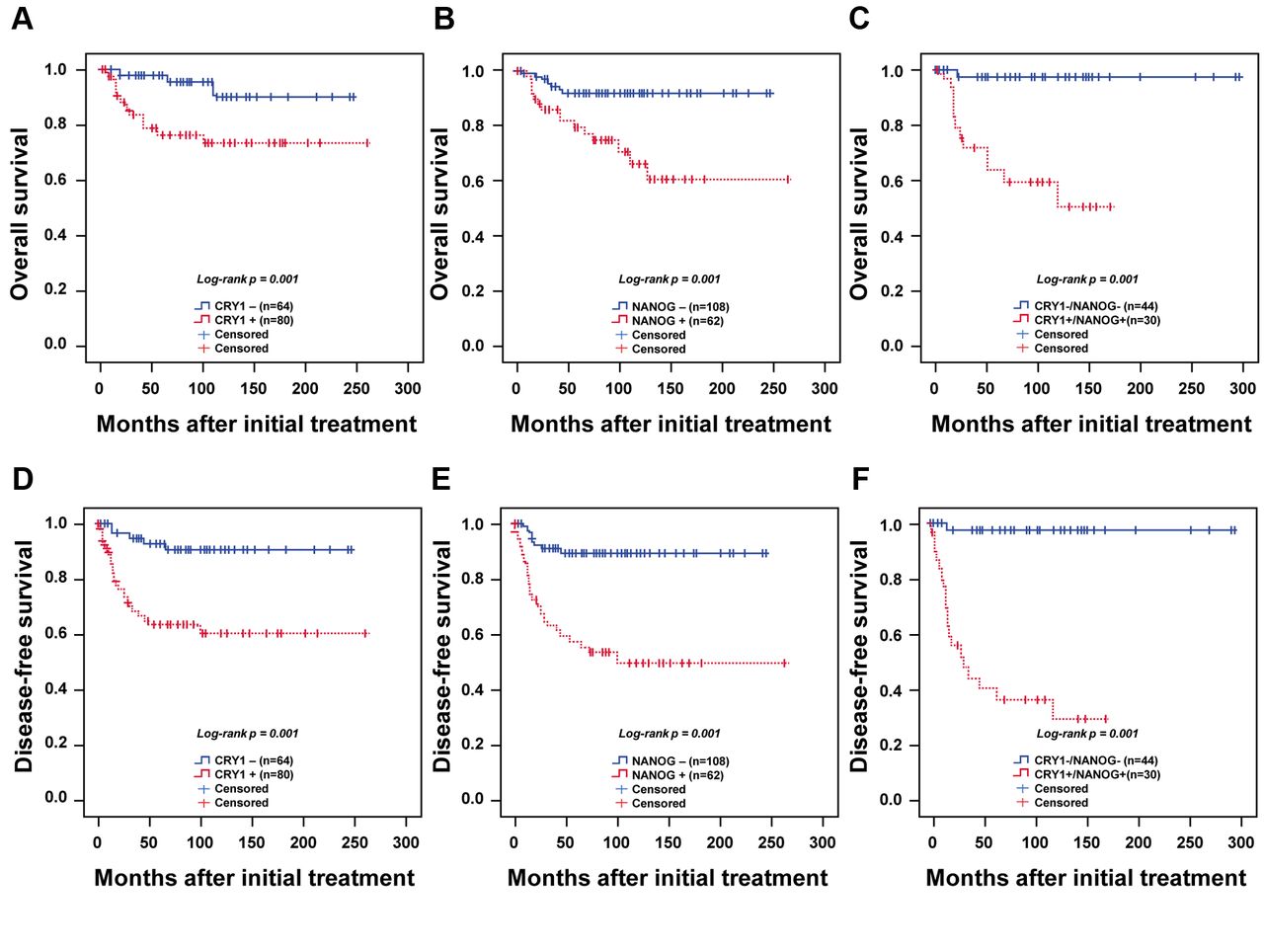
    Kaplan–Meier survival curves for CRY1 and NANOG expression in cervical cancer. Patients with cervical cancer over-expressing CRY1 showed worse (A) overall survival (p=0.001) and (D) disease-free survival (p=0.001) than those with low expression of CRY1. Cervical cancer patients with NANOG over-expression showed worse (B) overall survival (p=0.001) and (E) disease-free survival (p=0.001). Patients with over-expression of both CRY1 and NANOG showed worse (C) overall survival (p<0.001) and (F) disease-free survival (p<0.001) compared to patients with low expression of both CRY1 and NANOG.

  • Figure 3.
    • Download figure
    • Open in new tab
    • Download powerpoint
    Figure 3.
    • Download figure
    • Open in new tab
    • Download powerpoint
    Figure 3.

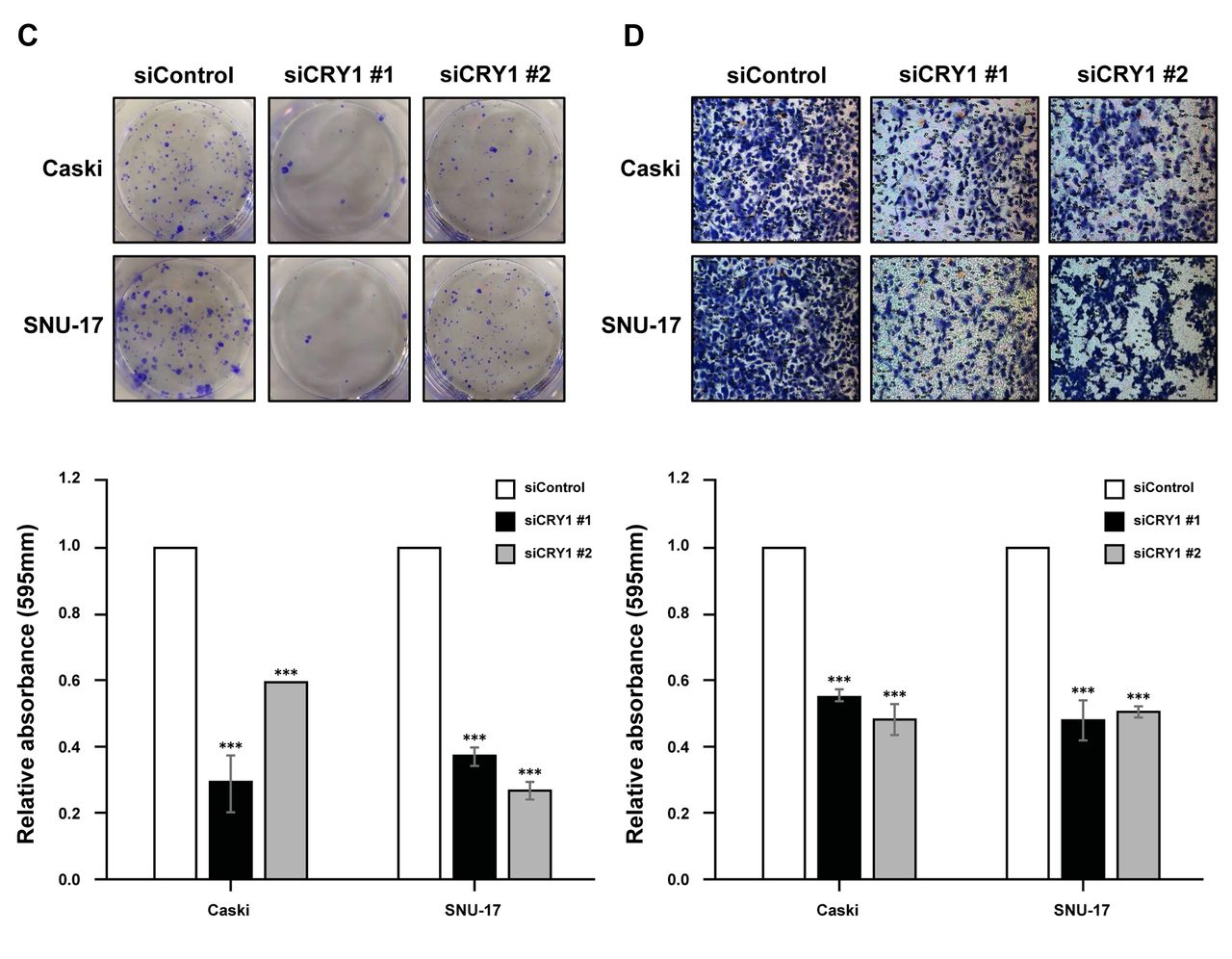
    Effect of CRY1 in cervical cancer cell lines. CRY1 was knocked down in Caski and SNU-17 cells for 72 h. (A) Protein expression of CRY1 and α-actinin was analysed by western blot. (B) The proliferation of siControl- and siCRY1-transfected Caski and SNU-17 cells was detected using EZ-Cytox assay, at indicated time points. (C) Colony formation was performed with siControl and siCRY1 transfected cell. Upper panel: representative image of colonogenic assay. Lower panel: quantitative results of colonogenic assay. (D) Cell invasion assay was conducted using the Boyden chamber assay. Upper panel: representative image of Boyden chamber assay. Lower panel: quantitative result of Boyden chamber assay. The number of asterisks (*) indicates the level of significance: **p<0.05, ***p<0.005. Error bars represent the mean±standard error (S.E) of triplicate experiments.

  • Figure 4.
    • Download figure
    • Open in new tab
    • Download powerpoint
    Figure 4.
    • Download figure
    • Open in new tab
    • Download powerpoint
    Figure 4.

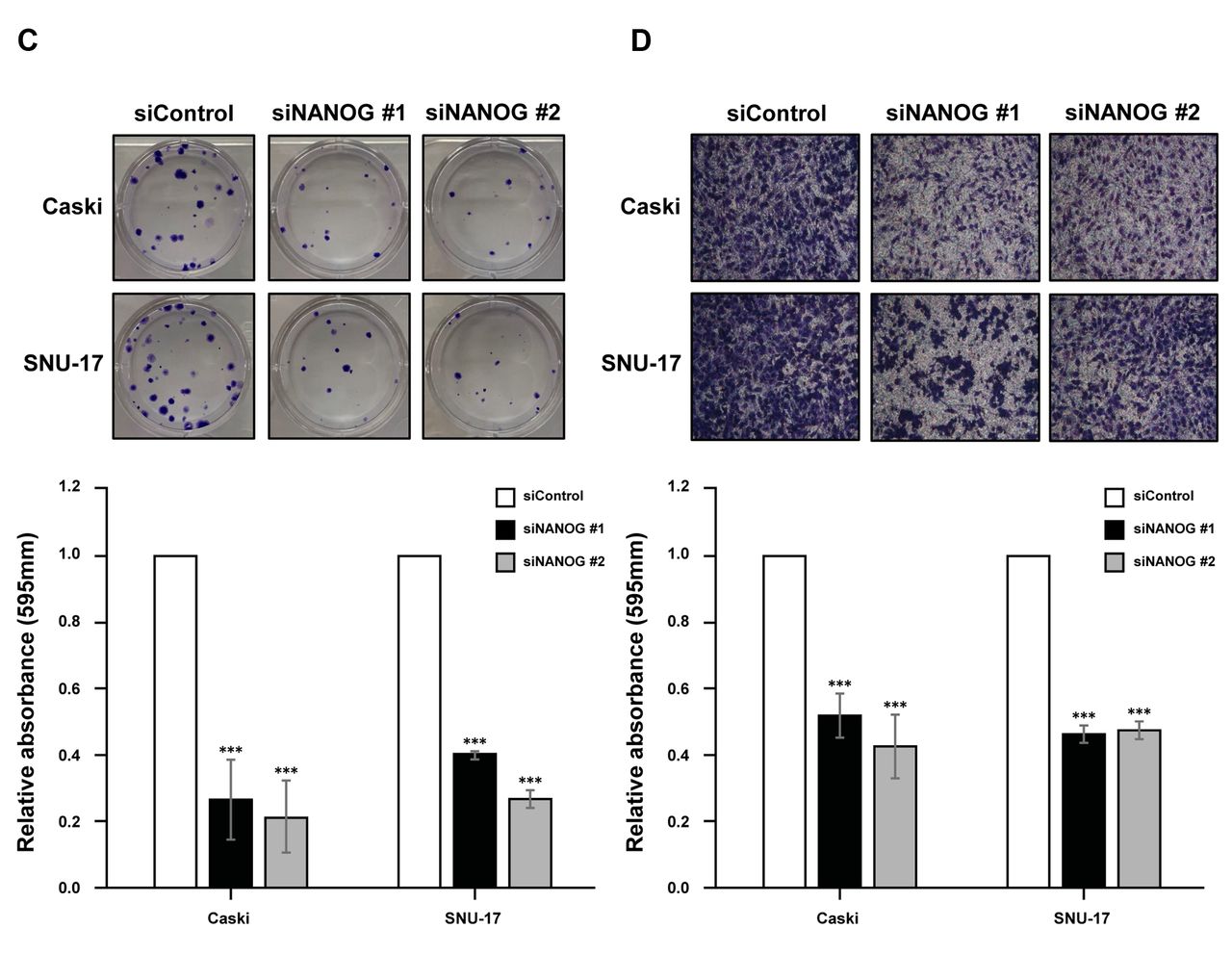
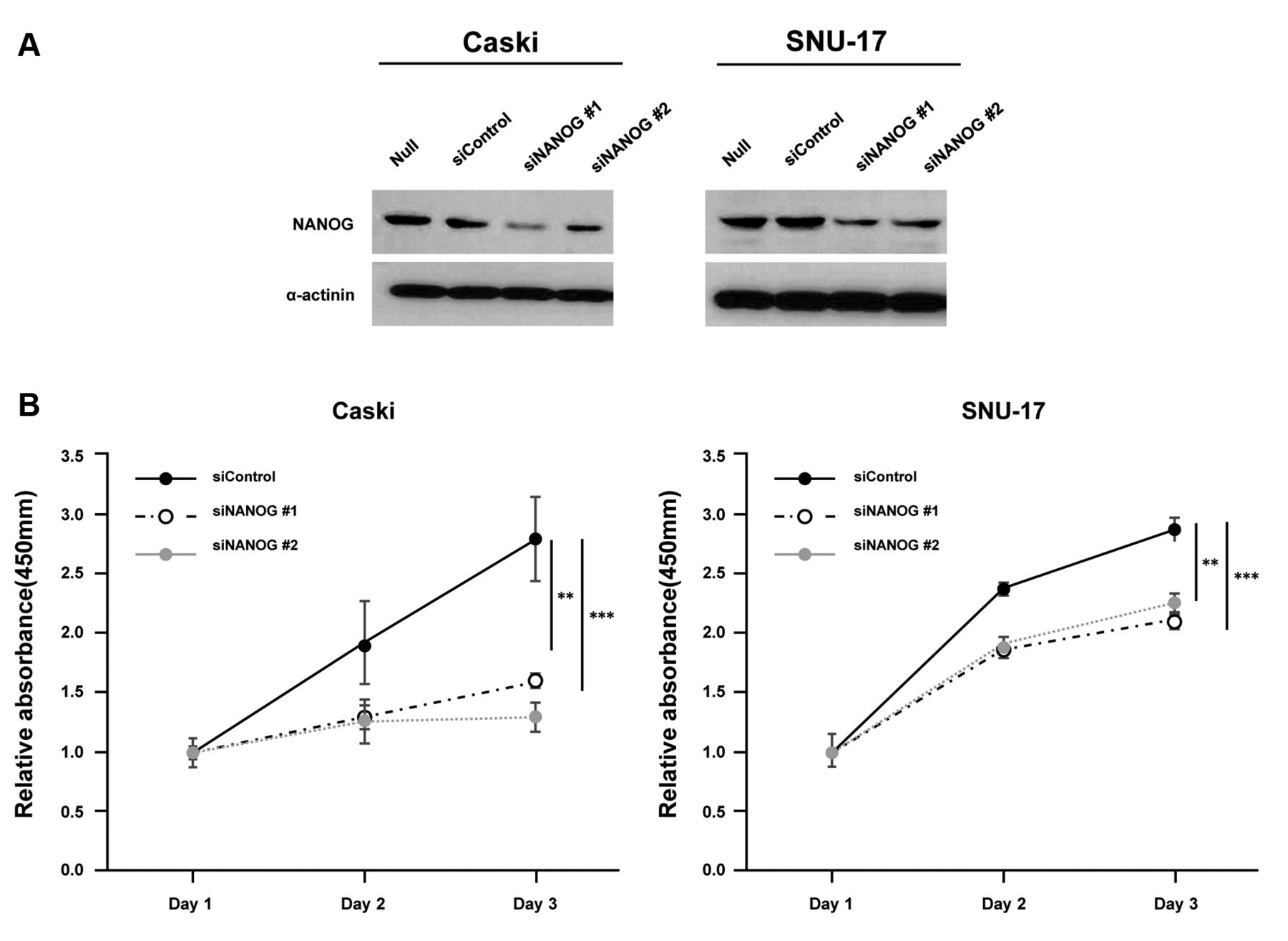
    Effect of NANOG expression in cervical cancer cell lines. NANO. G was knocked down in Caski and SNU-17 cells for 72 (A) Protein expression of NANOG and α-actinin was analysed by western blot. (B) The proliferation of siControl- and siNANOG-transfected Caski and SNU-17 cells was detected using EZ-Cytox assay, at indicated time points. (C) Colony formation was performed with siControl and siCRY1 transfected cell. Upper panel: representative image of colonogenic assay. Lower panel: quantitative results of colonogenic assay. (D) Cell invasion assay was conducted using the Boyden chamber assay. Upper panel: representative image of Boyden chamber assay. Lower panel: quantitative result of Boyden chamber assay. The number of asterisks (*) indicates the level of significance: **p<0.05, ***p<0.005. Error bars represent the mean±standard error (S.E) of triplicate experiments.

  • Figure 5.
    • Download figure
    • Open in new tab
    • Download powerpoint
    Figure 5.
    • Download figure
    • Open in new tab
    • Download powerpoint
    Figure 5.

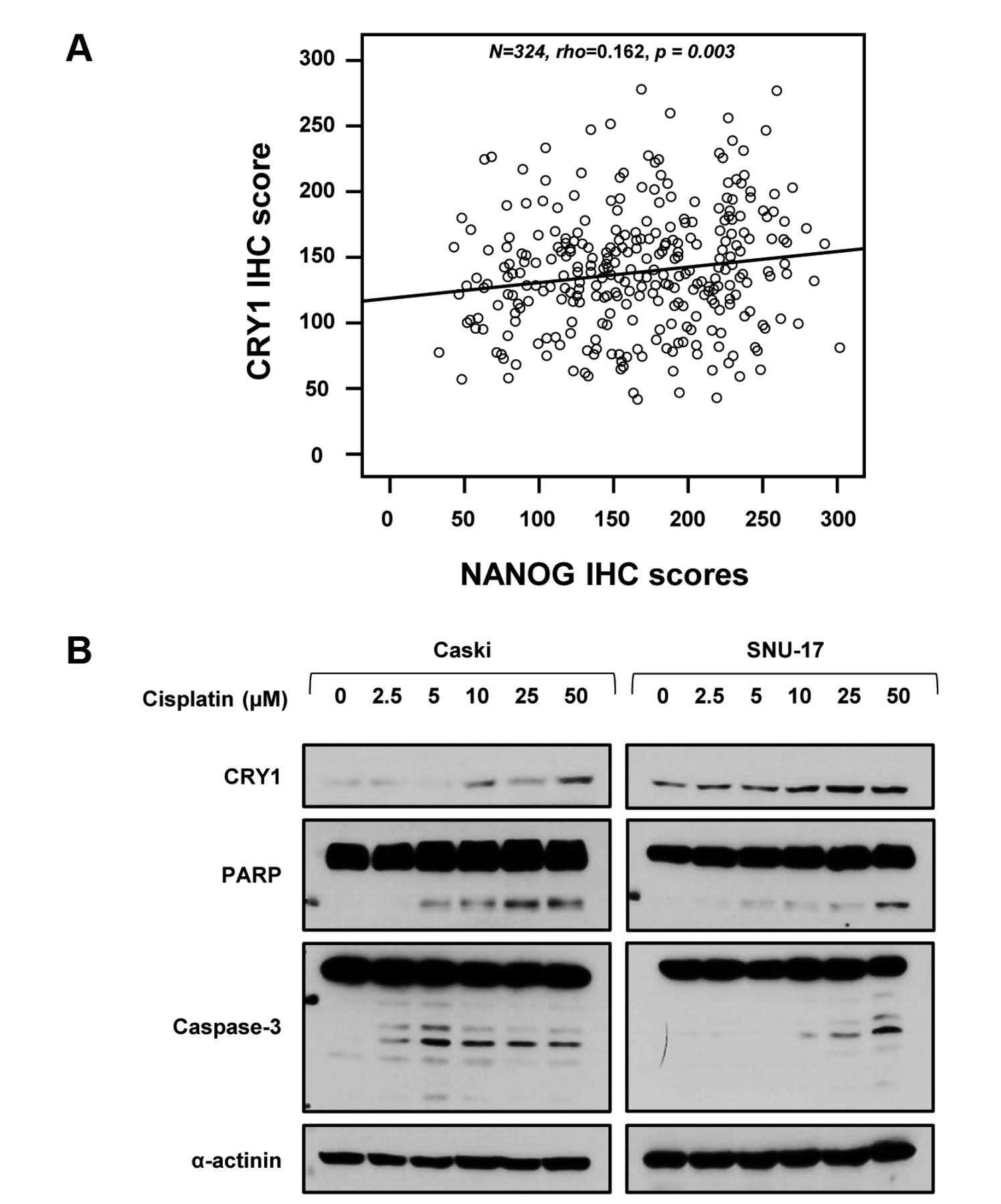
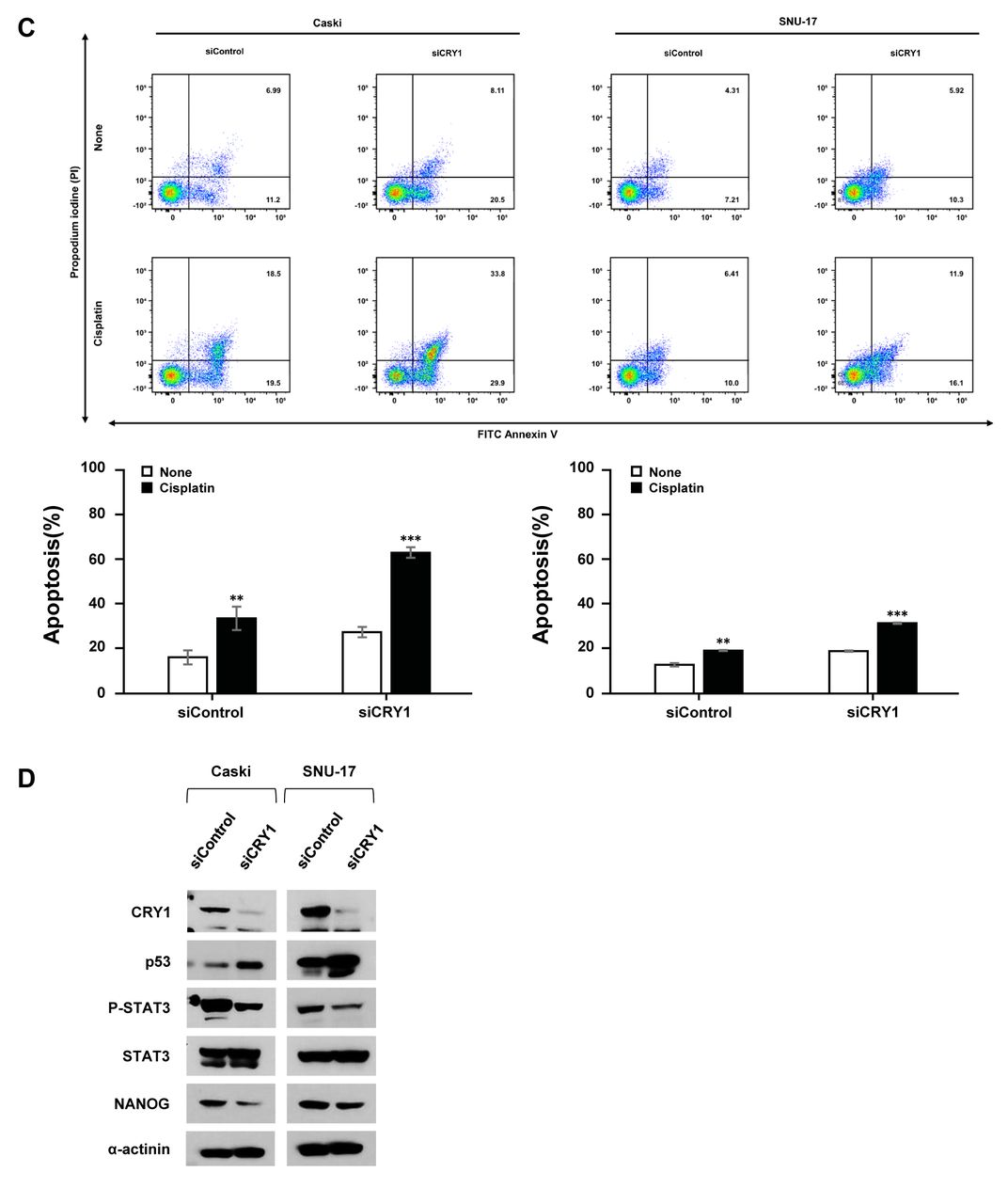
    Effects of CRY1 in apoptosis and correlation with NANOG expression in cervical cancer specimens and cell lines. (A) Spearman’s rank correlation analysis showed the positive correlation between CRY1 and NANOG expression in cervical cancer specimens (B) Caski and SNU-17 cells were treated with the indicated concentration of cisplatin for 48 h. Cells were harvested; protein expression of CRY1, PARP, Caspase-3, and α-actinin was analyzed by western blot. (C) CRY1 was knocked down in Caski and SNU-17 cells for 48 h and then cells were treated with 100 μM cisplatin for 48 h. Cells were then harvested and apoptosis was analyzed using flow cytometry after staining with annexin V-FITC/propidium iodide. Upper panel: representative scatter plots of propidium iodide (y-axis) versus annexin V (x-axis). Lower panel: Quantitative analysis of the apoptotic cells. (D) CRY1 was knocked down in Caski and SNU-17 cells for 72 h. Cells were then harvested and protein expression and activation status of CRY1, p53, P-STAT3, STAT3, NANOG, and α-actinin were analysed by western blot. The number of asterisks (*) indicates the level of significance: **p<0.05, ***p<0.005. Error bars represent mean±standard error (S.E) of triplicate experiments.

Tables

  • Figures
  • Table I.
  • Table II.
PreviousNext
Back to top

In this issue

Cancer Genomics & Proteomics
Vol. 18, Issue 6
November-December 2021
  • Table of Contents
  • Table of Contents (PDF)
  • Index by author
  • Back Matter (PDF)
  • Ed Board (PDF)
  • Front Matter (PDF)
Print
Download PDF
Article Alerts
Sign In to Email Alerts with your Email Address
Email Article

Thank you for your interest in spreading the word on Cancer Genomics & Proteomics.

NOTE: We only request your email address so that the person you are recommending the page to knows that you wanted them to see it, and that it is not junk mail. We do not capture any email address.

Enter multiple addresses on separate lines or separate them with commas.
CRY1 Regulates Chemoresistance in Association With NANOG by Inhibiting Apoptosis via STAT3 Pathway in Patients With Cervical Cancer
(Your Name) has sent you a message from Cancer Genomics & Proteomics
(Your Name) thought you would like to see the Cancer Genomics & Proteomics web site.
CAPTCHA
This question is for testing whether or not you are a human visitor and to prevent automated spam submissions.
5 + 8 =
Solve this simple math problem and enter the result. E.g. for 1+3, enter 4.
Citation Tools
CRY1 Regulates Chemoresistance in Association With NANOG by Inhibiting Apoptosis via STAT3 Pathway in Patients With Cervical Cancer
GWAN HEE HAN, JULIE KIM, HEE YUN, HANBYOUL CHO, JOON-YONG CHUNG, JAE-HOON KIM, STEPHEN M. HEWITT
Cancer Genomics & Proteomics Nov 2021, 18 (6) 699-713; DOI: 10.21873/cgp.20291

Citation Manager Formats

  • BibTeX
  • Bookends
  • EasyBib
  • EndNote (tagged)
  • EndNote 8 (xml)
  • Medlars
  • Mendeley
  • Papers
  • RefWorks Tagged
  • Ref Manager
  • RIS
  • Zotero
Reprints and Permissions
Share
CRY1 Regulates Chemoresistance in Association With NANOG by Inhibiting Apoptosis via STAT3 Pathway in Patients With Cervical Cancer
GWAN HEE HAN, JULIE KIM, HEE YUN, HANBYOUL CHO, JOON-YONG CHUNG, JAE-HOON KIM, STEPHEN M. HEWITT
Cancer Genomics & Proteomics Nov 2021, 18 (6) 699-713; DOI: 10.21873/cgp.20291
Twitter logo Facebook logo Mendeley logo
  • Tweet Widget
  • Facebook Like
  • Google Plus One

Jump to section

  • Article
    • Abstract
    • Materials and Methods
    • Results
    • Discussion
    • Acknowledgements
    • Footnotes
    • References
  • Figures & Data
  • Info & Metrics
  • PDF

Related Articles

Cited By...

  • No citing articles found.
  • Google Scholar

More in this TOC Section

  • Recurrent 8q11-13 Aberrations Leading to PLAG1 Rearrangements, Including Novel Chimeras HNRNPA2B1::PLAG1 and SDCBP::PLAG1, in Lipomatous Tumors
  • Receptor for Hyaluronic Acid-mediated Motility (RHAMM) Is Associated With Prostate Cancer Migration and Poor Prognosis
  • Oncogenes and Methionine Addiction of Cancer: Role of c-MYC
Show more Article

Keywords

  • CRY1
  • NANOG
  • apoptosis
  • Cervical cancer
  • biomarker
  • chemoradiation response
Cancer & Genome Proteomics

© 2026 Cancer Genomics & Proteomics

Powered by HighWire