Main menu

  • Home
  • Current Issue
  • Archive
  • Info for
    • Authors
    • Editorial Policies
    • Advertisers
    • Editorial Board
    • Special Issues
  • Journal Metrics
  • Other Publications
    • Anticancer Research
    • In Vivo
    • Cancer Diagnosis & Prognosis
  • More
    • IIAR
    • Conferences
  • About Us
    • General Policy
    • Contact
  • Other Publications
    • Cancer Genomics & Proteomics
    • Anticancer Research
    • In Vivo

User menu

  • Register
  • Subscribe
  • My alerts
  • Log in
  • My Cart

Search

  • Advanced search
Cancer Genomics & Proteomics
  • Other Publications
    • Cancer Genomics & Proteomics
    • Anticancer Research
    • In Vivo
  • Register
  • Subscribe
  • My alerts
  • Log in
  • My Cart
Cancer Genomics & Proteomics

Advanced Search

  • Home
  • Current Issue
  • Archive
  • Info for
    • Authors
    • Editorial Policies
    • Advertisers
    • Editorial Board
    • Special Issues
  • Journal Metrics
  • Other Publications
    • Anticancer Research
    • In Vivo
    • Cancer Diagnosis & Prognosis
  • More
    • IIAR
    • Conferences
  • About Us
    • General Policy
    • Contact
  • Visit iiar on Facebook
  • Follow us on Linkedin
Research Article
Open Access

Three Poliovirus Sequences in the Human Genome Associated With Colorectal Cancer

STEVEN LEHRER and PETER H. RHEINSTEIN
Cancer Genomics & Proteomics January 2019, 16 (1) 65-70; DOI: https://doi.org/10.21873/cgp.20112
STEVEN LEHRER
1Radiation Oncology, Mount Sinai Medical Center, New York, NY, U.S.A.
  • Find this author on Google Scholar
  • Find this author on PubMed
  • Search for this author on this site
  • For correspondence: steven.lehrer{at}mssm.edu
PETER H. RHEINSTEIN
2Severn Health Solutions, Severna Park, MD, U.S.A.
  • Find this author on Google Scholar
  • Find this author on PubMed
  • Search for this author on this site
  • Article
  • Figures & Data
  • Info & Metrics
  • PDF
Loading

Article Figures & Data

Figures

  • Figure 1.
    • Download figure
    • Open in new tab
    • Download powerpoint
    Figure 1.

    In chromosome 20p12.1, a poliovirus sequence with almost 100% identity, consisting of a sense and an antisense strand of 32 nucleotides (6380 to 6411), which codes for the 3Dpol, an RNA dependent RNA polymerase whose function is to make multiple copies of the viral RNA genome. The viral sequence is in an intronic region of the MACROD2 gene, indicated by the dashed lines of Gencode. Red line: Genome and poliovirus sequence have different bases at this position. Green line: The poliovirus sequence appears to have a polyA tail that is not aligned to the genome (https://genome.ucsc.edu).

  • Figure 2.
    • Download figure
    • Open in new tab
    • Download powerpoint
    Figure 2.

    Colon adenoma stained with HPA049076 anti-MACROD2 antibody produced in rabbit (Human Protein Atlas available from www.proteinatlas.org).

  • Figure 3.
    • Download figure
    • Open in new tab
    • Download powerpoint
    Figure 3.

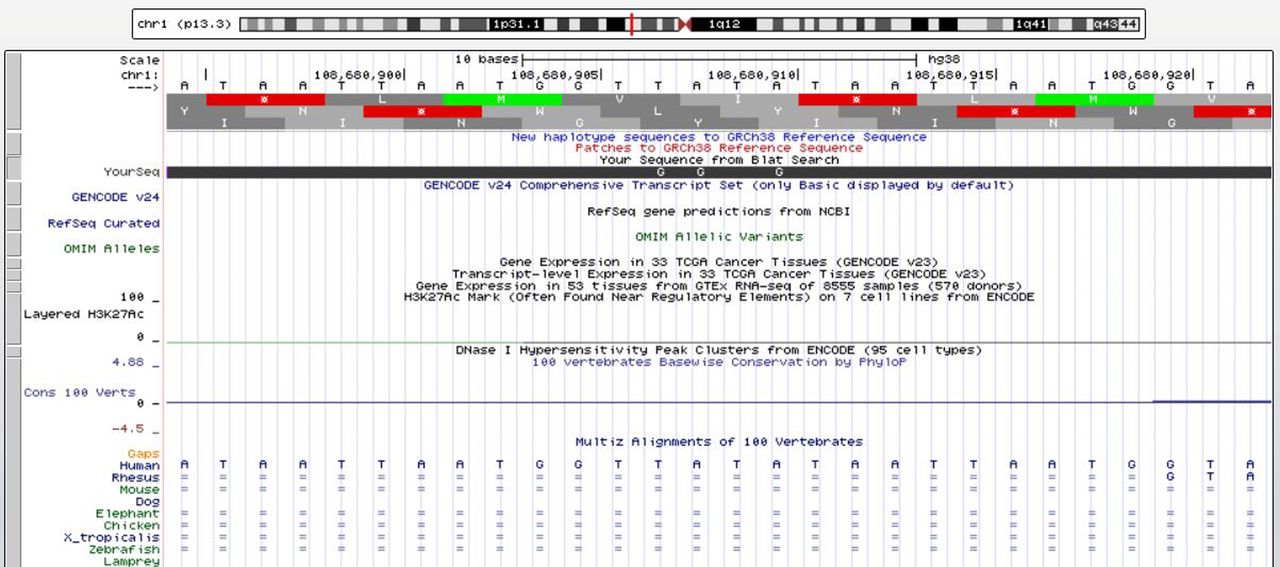
    In chromosome 1p13.3 a poliovirus sequence with 89.3% identity, consisting of a sense and an antisense strand of 28 nucleotides, 811 through 838, which code for the VP4 protein of the viral capsid. The viral sequence is within an intronic region of the solute carrier family 25 member 24 gene (SLC25A24). Red line: Genome and poliovirus sequence have different bases at this position. Green line: The poliovirus sequence appears to have a polyA tail that is not aligned to the genome (https://genome.ucsc.edu).

  • Figure 4.
    • Download figure
    • Open in new tab
    • Download powerpoint
    Figure 4.

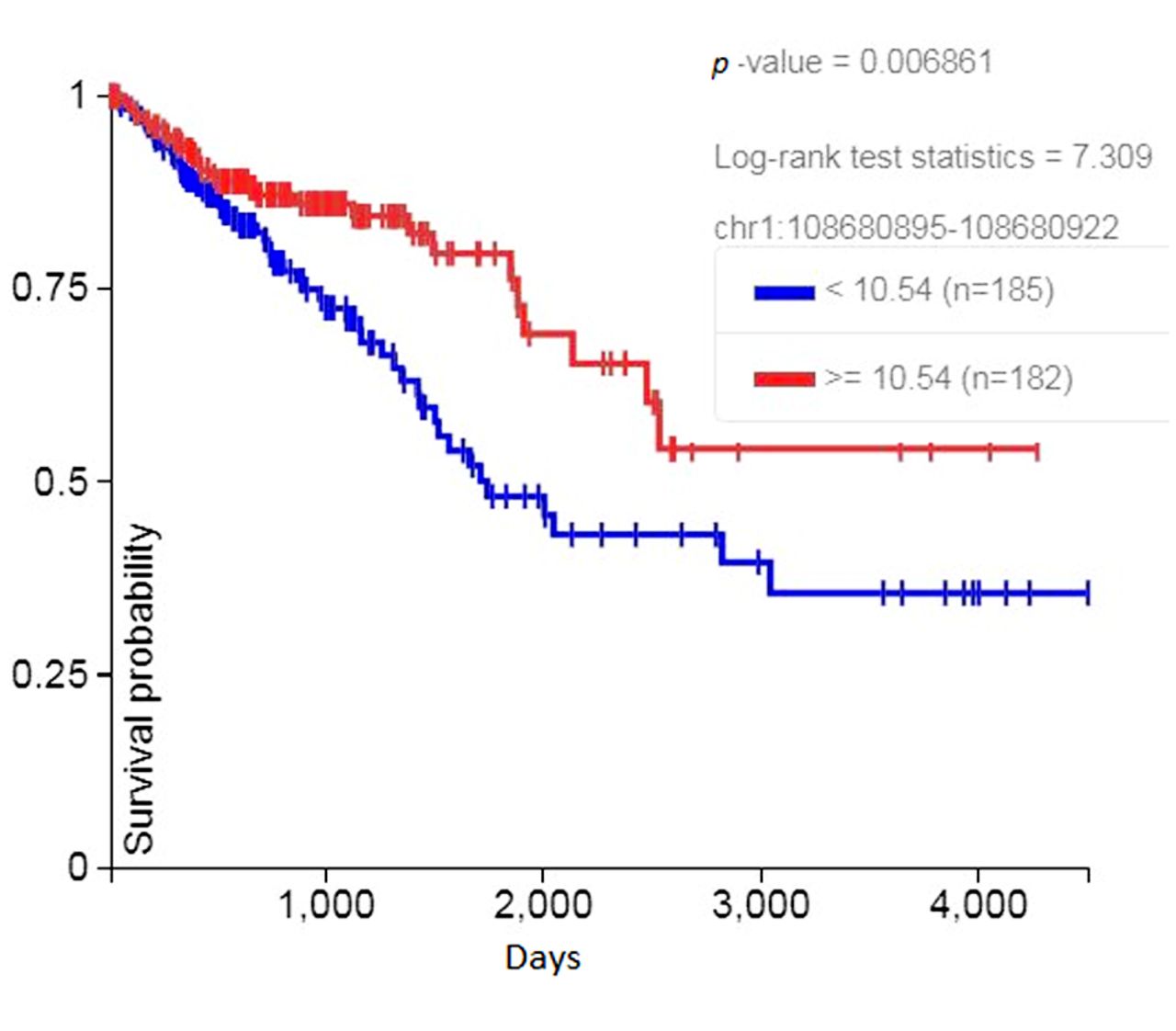
    Increased RNA expression of the SLC25A24 gene poliovirus sequence on chromosome 1p13.3 was associated with significantly increased survival in colorectal cancer patients.

  • Figure 5.
    • Download figure
    • Open in new tab
    • Download powerpoint
    Figure 5.

    In chromosome 2p25.1, a poliovirus sequence with almost 100% identity, consisting of two sense strands, 20 nucleotides, 7106 through 7125, which codes for the 3Dpol. Red line: Genome and poliovirus sequence have different bases at this position (https://genome.ucsc.edu).

  • Figure 6.
    • Download figure
    • Open in new tab
    • Download powerpoint
    Figure 6.

    Analysis of the COAD (adenocarcinoma of the colon) cohort in TCGA: relationship of PVR, the poliovirus cellular receptor, to FCAR, a gene that encodes a receptor for the Fc region of Immunoglobulin A. There is a significant correlation in copy number alterations of both genes. Number of cases in each box (http://www.cbioportal.org).

  • Figure 7.
    • Download figure
    • Open in new tab
    • Download powerpoint
    Figure 7.

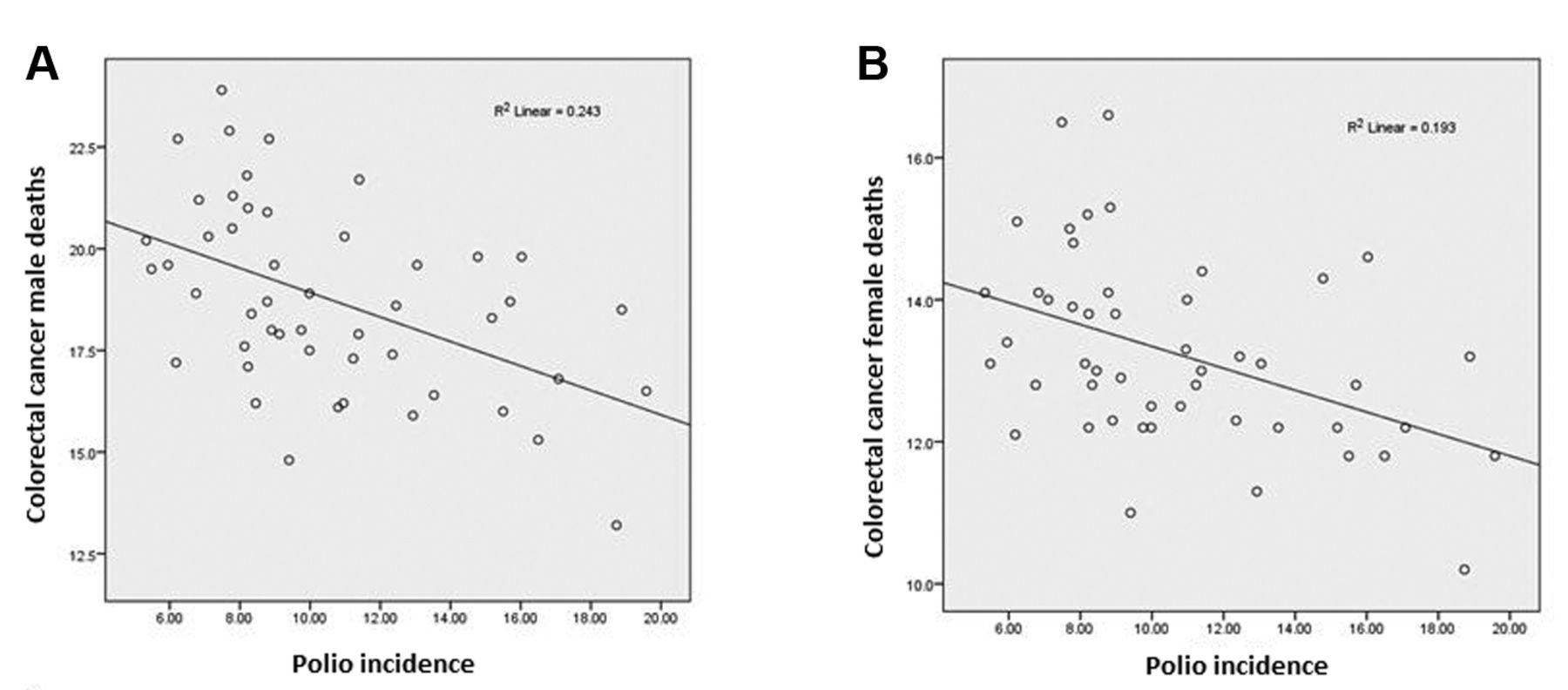
    Polio incidence in 48 states (1937-1951) versus colorectal cancer deaths per 100,000 (2005-2009). The correlation was significant for men (A: r=−0.493, p<0.0005) and women (B: r=−0.440, p=0.002). Alaska and Hawaii were not States in 1951.

PreviousNext
Back to top

In this issue

Cancer Genomics & Proteomics
Vol. 16, Issue 1
January-February 2019
  • Table of Contents
  • Table of Contents (PDF)
  • Index by author
  • Back Matter (PDF)
  • Ed Board (PDF)
  • Front Matter (PDF)
Print
Download PDF
Article Alerts
Sign In to Email Alerts with your Email Address
Email Article

Thank you for your interest in spreading the word on Cancer Genomics & Proteomics.

NOTE: We only request your email address so that the person you are recommending the page to knows that you wanted them to see it, and that it is not junk mail. We do not capture any email address.

Enter multiple addresses on separate lines or separate them with commas.
Three Poliovirus Sequences in the Human Genome Associated With Colorectal Cancer
(Your Name) has sent you a message from Cancer Genomics & Proteomics
(Your Name) thought you would like to see the Cancer Genomics & Proteomics web site.
CAPTCHA
This question is for testing whether or not you are a human visitor and to prevent automated spam submissions.
1 + 0 =
Solve this simple math problem and enter the result. E.g. for 1+3, enter 4.
Citation Tools
Three Poliovirus Sequences in the Human Genome Associated With Colorectal Cancer
STEVEN LEHRER, PETER H. RHEINSTEIN
Cancer Genomics & Proteomics Jan 2019, 16 (1) 65-70; DOI: 10.21873/cgp.20112

Citation Manager Formats

  • BibTeX
  • Bookends
  • EasyBib
  • EndNote (tagged)
  • EndNote 8 (xml)
  • Medlars
  • Mendeley
  • Papers
  • RefWorks Tagged
  • Ref Manager
  • RIS
  • Zotero
Reprints and Permissions
Share
Three Poliovirus Sequences in the Human Genome Associated With Colorectal Cancer
STEVEN LEHRER, PETER H. RHEINSTEIN
Cancer Genomics & Proteomics Jan 2019, 16 (1) 65-70; DOI: 10.21873/cgp.20112
Twitter logo Facebook logo Mendeley logo
  • Tweet Widget
  • Facebook Like
  • Google Plus One

Jump to section

  • Article
    • Abstract
    • Materials and Methods
    • Results
    • Discussion
    • Footnotes
    • References
  • Figures & Data
  • Info & Metrics
  • PDF

Related Articles

Cited By...

  • Human Gene Sequences in SARS-CoV-2 and Other Viruses
  • Google Scholar

Keywords

  • Polio virus
  • Colorectal cancer
  • the UCSC Genome Browser
  • The Cancer Genome Atlas
  • cancer vaccines
Cancer & Genome Proteomics

© 2026 Cancer Genomics & Proteomics

Powered by HighWire