Main menu

  • Home
  • Current Issue
  • Archive
  • Info for
    • Authors
    • Editorial Policies
    • Advertisers
    • Editorial Board
    • Special Issues
  • Journal Metrics
  • Other Publications
    • Anticancer Research
    • In Vivo
    • Cancer Diagnosis & Prognosis
  • More
    • IIAR
    • Conferences
  • About Us
    • General Policy
    • Contact
  • Other Publications
    • Cancer Genomics & Proteomics
    • Anticancer Research
    • In Vivo

User menu

  • Register
  • Subscribe
  • My alerts
  • Log in
  • My Cart

Search

  • Advanced search
Cancer Genomics & Proteomics
  • Other Publications
    • Cancer Genomics & Proteomics
    • Anticancer Research
    • In Vivo
  • Register
  • Subscribe
  • My alerts
  • Log in
  • My Cart
Cancer Genomics & Proteomics

Advanced Search

  • Home
  • Current Issue
  • Archive
  • Info for
    • Authors
    • Editorial Policies
    • Advertisers
    • Editorial Board
    • Special Issues
  • Journal Metrics
  • Other Publications
    • Anticancer Research
    • In Vivo
    • Cancer Diagnosis & Prognosis
  • More
    • IIAR
    • Conferences
  • About Us
    • General Policy
    • Contact
  • Visit iiar on Facebook
  • Follow us on Linkedin
Research Article
Open Access

Gene-expression Profiling in Patients with Plasma Cell Myeloma Treated with Novel Agents

MICHAEL MEDINGER, JÖRG HALTER, DOMINIK HEIM, ANDREAS BUSER, SABINE GERULL, CLAUDIA LENGERKE and JAKOB PASSWEG
Cancer Genomics & Proteomics July 2016, 13 (4) 275-279;
MICHAEL MEDINGER
1Division of Hematology, Department of Medicine, University Hospital Basel, Basel, Switzerland
2Division of Internal Medicine, Department of Medicine, University Hospital Basel, Basel, Switzerland
  • Find this author on Google Scholar
  • Find this author on PubMed
  • Search for this author on this site
  • For correspondence: medingerm{at}uhbs.ch
JÖRG HALTER
1Division of Hematology, Department of Medicine, University Hospital Basel, Basel, Switzerland
  • Find this author on Google Scholar
  • Find this author on PubMed
  • Search for this author on this site
DOMINIK HEIM
1Division of Hematology, Department of Medicine, University Hospital Basel, Basel, Switzerland
  • Find this author on Google Scholar
  • Find this author on PubMed
  • Search for this author on this site
ANDREAS BUSER
1Division of Hematology, Department of Medicine, University Hospital Basel, Basel, Switzerland
  • Find this author on Google Scholar
  • Find this author on PubMed
  • Search for this author on this site
SABINE GERULL
1Division of Hematology, Department of Medicine, University Hospital Basel, Basel, Switzerland
  • Find this author on Google Scholar
  • Find this author on PubMed
  • Search for this author on this site
CLAUDIA LENGERKE
1Division of Hematology, Department of Medicine, University Hospital Basel, Basel, Switzerland
  • Find this author on Google Scholar
  • Find this author on PubMed
  • Search for this author on this site
JAKOB PASSWEG
1Division of Hematology, Department of Medicine, University Hospital Basel, Basel, Switzerland
  • Find this author on Google Scholar
  • Find this author on PubMed
  • Search for this author on this site
  • Article
  • Figures & Data
  • Info & Metrics
  • PDF
Loading

Abstract

Background/Aim: Novel agents such as thalidomide, lenalidomide and bortezomib have in part anti-angiogenic properties. In this study, we examined gene expression of angiogenic molecules in patients with plasma cell myeloma (PCM). Materials and Methods: We included 93 patients with PCM treated with novel agents (immunomodulatory drugs (IMiDs), bortezomib or a combination of both). The mRNA levels of angiogenic molecules were measured using the Human Angiogenesis RT2 Profiler PCR Array. The response evaluation was performed after three cycles. Results: Regarding all 93 patients, gene expression of 15 out of 84 genes tested (pre- and post-treatment and changes in levels pre-treatment/post-treatment) were significantly different in responders compared to non-responders. Responders had a lower expression of pro-angiogenic factors and increased expression of antiangiogenic factors. Conclusion: In the IMiD-treated groups we found significant changes of expression of angiogenic genes in responders compared to non-responders, whereas in the bortezomib-based group the difference in expression of angiogenic genes was not significant.

  • Angiogenesis
  • bortezomib
  • gene expression
  • immunomodulatory drugs
  • plasma cell myeloma

Plasma cell myeloma (PCM) is a prevalent disease which accounts for about 1% of all neoplasias and more than 10% of all hematological malignancies. It has a poor prognosis, with a median survival of 3-5 years, despite all treatment approaches, including intensive chemotherapy followed by hematopoietic stem cell transplantation (1). The introduction of new therapeutic strategies, such as lenalidomide and bortezomib, which target malignant plasma cells to affect their interactions with the bone marrow microenvironment, has changed the management of PCM and has improved survival rates (2, 3). In patients with myelodysplastic syndrome (MDS) and del(5q), lenalidomide treatment changes expression of genes involved in the tumor necrosis factor (TNF) signaling pathway after treatment, which suggests that lenalidomide affects inflammation (4). Bortezomib is a proteasome inhibitor known to induce apoptosis, reverse drug resistance of PCM cells, and block cytokine effects, cell adhesion, and angiogenesis in the myeloma cell microenvironment, all of which support the proliferation and migration of neoplastic plasma cells (5).

Recent studies have revealed that thalidomide, lenalidomide, and pomalidomide share a novel pharmacologic mechanism of action (6). The drugs bind to an E3 ubiquitin ligase complex and modulate its substrate specificity, resulting in the proteasomal degradation of specific disease-related proteins. In lymphocytes, these drugs induce rapid and effective degradation of Ikaros (IKZF1) and Aiolos (IKZF3), two zinc finger transcription factors that would generally be considered ‘undruggable’. Degradation of IKZF1 and IKZF3 provides a mechanism for the effects of lenalidomide in PCM. IKZF1 and IKZF3 are transcription factors that are essential for B-cell differentiation, and PCM cells require ongoing expression of IKZF1 and IKZF3 for survival (6). Given this mechanism of action, it is intriguing that immunomodulatory drugs (IMiDs) and proteasome inhibitors may be synergistic in the treatment of PCM.

PCM was the first hematological malignancy in which an increased rate of angiogenesis was detected (7). Angiogenesis, or new blood vessel formation, is fundamental to the growth and spread of tumors. New vessel formation in the bone marrow seems to play an important role in the pathogenesis of PCM (8). Increased bone marrow microvessel density in patients with PCM also appears to be an important prognostic factor (9). Malignant plasma cells can secrete various cytokines, including vascular endothelial growth factor (VEGF), basic fibroblast growth factor (bFGF), and hepatocyte growth factor (HGF), all known for their proangiogenic activity (10, 11). It was shown that PCM cells are capable of secreting VEGF in response to interleukin-6 (IL6) stimulation; in response to such VEGF stimulation, microvascular endothelial cells and bone marrow stromal cells secrete IL6, a potent growth factor for malignant plasma cells, thus closing a paracrine loop (8). Tight control of angiogenesis is maintained by a balance of endogenous antiangiogenic and proangiogenic factors (12). VEGF plays a key rate-limiting role in promoting tumor angiogenesis and exerts its effects by binding to one of three receptor tyrosine kinases: VEGF receptor-1 (VEGFR1; fms-like tyrosine kinase-1, FLT1), VEGFR2 (human kinase domain region, KDR/murine fetal liver kinase-1, FLK1), and VEGFR3 (FLT4) (13). In previous studies, we showed that serum angiogenic markers in patients with PCM correlated to treatment response to novel agents (14).

The aim of this study was to investigate expression of 84 genes involved in angiogenesis in patients with PCM and to correlate these markers with treatment response to novel agents.

Materials and Methods

The study was performed according to the regulations of the local Ethics Committee (approval number 334/10). The study population [already published (14)] included 93 patients newly diagnosed with PCM at our institution between 2009 and 2015 (60 men, 33 women; median age=59 years, range=30-75 years) fulfilling the International Myeloma Working Group diagnostic criteria (1). Baseline patient characteristics are shown in Table I. None of the patients had received any myeloma-related therapy prior to the study.

All patients received treatment with novel drugs, using either thalidomide or lenalidomide (IMiD)-based regimens (n=29) (such as melphalan, prednisone and thalidomide; lenalidomide and dexamethasone), bortezomib-based regimens (n=30) (such as bortezomib, melphalan and prednisone; bortezomib, cyclophosphamide and dexamethasone; bortezomib and dexamethasone), or a combination of IMiD and bortezomib-based regimen (n=34) (such as bortezomib, thalidomide and dexamethasone).

Response to treatment and relapse/progression events were classified according to consensus guidelines (15). The study population was divided into two groups after therapy: responders (stringent complete response, complete response, very good partial response, partial response) and non-responders (stable disease, progressive disease). For each patient, gene expression was measured at diagnosis and after three cycles of therapy, when treatment response was assessed.

Bone marrow plasma cells were purified using CD138 microbeads (Miltenyi Biotec, Bergisch-Gladbach, Germany), and purity was assessed by flow cytometry (FACSCalibur; BD Biosciences, Heidelberg, Germany). Gene expression profiling using the Angiogenesis RT2 Profiler PCR Array (SA Biosciences, Frederick, MD, USA) was conducted. This platform is designed to profile the expression of 84 key genes in angiogenesis (for a comprehensive list of genes included in this array see http://www.sabiosciences.com). Relative gene expression was determined using the ΔΔCT method. Data were further analyzed with the PCR Array Data Analysis Web Portal (http://www.SABiosciences.com/pcrarraydataanalysis.php). Three independent experiments were performed.

View this table:
  • View inline
  • View popup
  • Download powerpoint
Table I.

Baseline characteristics of patients.

Statistical analysis. Alteration of angiogenic gene expression from pre-treatment to post-treatment were assessed among responders and non-responders using paired t-test or Wilcoxon test as appropriate (repeated-measure analysis of variance method was used to compare the changes in pre-treatment and post-treatment expression of angiogenic gene in subgroups with different treatment responses). Values were considered significant at a p-value of less than 0.05.

Results

In our study, we found changes in angiogenic gene levels under therapy with novel agents, especially IMiD-based regimens, in patients with PCM. Of the 93 patients, 29 were treated with an IMiD-based regimen, 30 with a bortezomib-based regimen and 34 with the combination (IMiD/bortezomib) (Table I). The complete response plus very good partial response rate was 45% in the IMiD-based group (13/29), 52% in the bortezomib-based group (16/30) and 58% in the IMiD/bortezomib combination group (20/34).

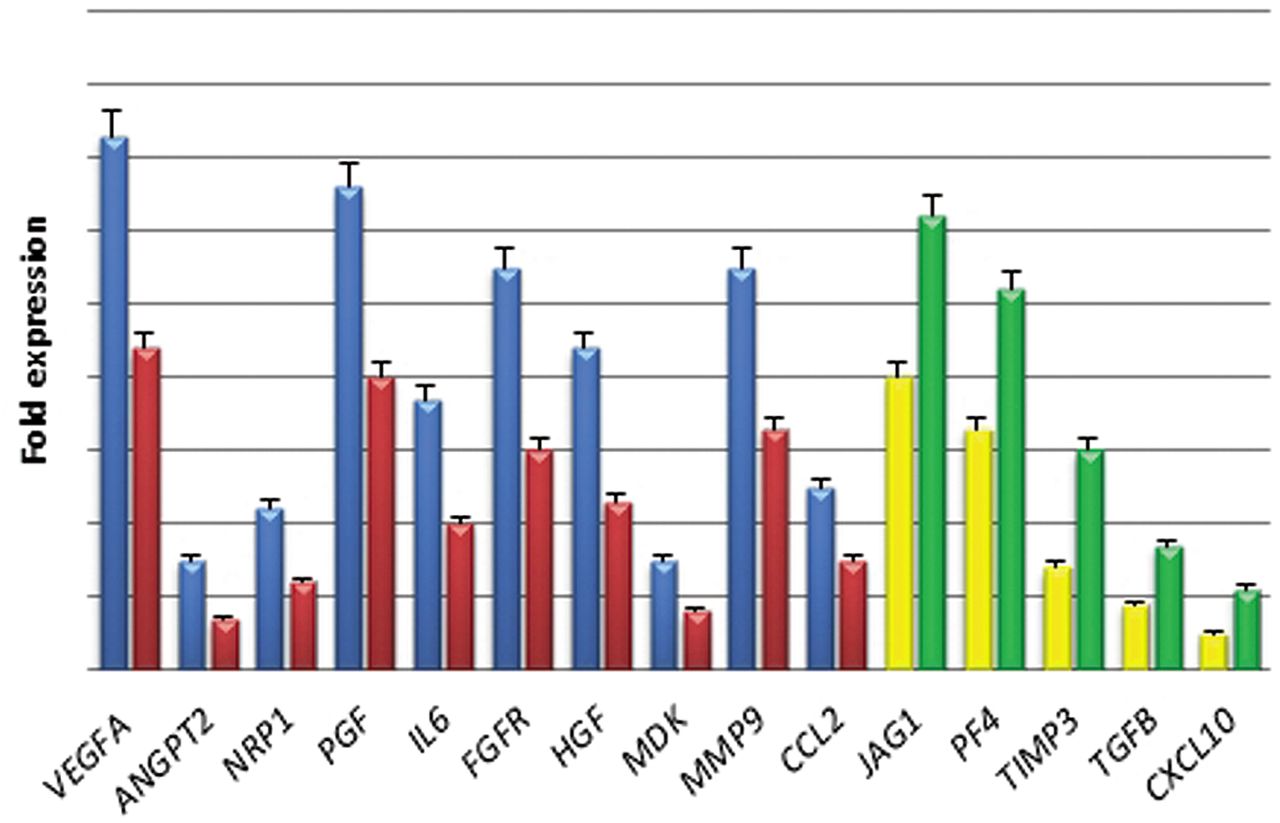
Regarding all 93 patients, gene expression of 15 out of 84 genes tested (pre-and post-treatment and changes in levels pre-treatment/post-treatment) were significantly different in responders compared to non-responders (Figure 1). Responders had lower expression of pro-angiogenic factors [e.g. C-C motif chemokine ligand 2 (CCL2), hepatocyte growth factor (HGF), midkine neurite growth-promoting factor 2 (MDK), placental growth factor (PGF), interleukin-6 (IL6), vascular endothelial growth factor A (VEGFA), angiopoietin 2 (ANGPT2), neuropilin 1 (NRP1), fibroblast growth factor receptor (FGFR) and matrix metallopeptidase 9 (MMP9)] and increased expression of anti-angiogenic factors [e.g. TIMP metallopeptidase inhibitor 3 TIMP3), transforming growth factor beta (TGFB), platelet factor 4 (PF4), jagged 1 (JAG1) and C-X-C motif chemokine ligand 10 (CXCL10)]. In the different treatment groups, the levels of angiogenic genes (14/84) were significantly different in responders compared to non-responders in the IMiD-based group and the combination group after three cycles of therapy but not in the bortezomib-based group.

Figure 1.
  • Download figure
  • Open in new tab
  • Download powerpoint
Figure 1.

Changes of fold expression of most commonly deregulated angiogenesis-related genes measured by quantitative real-time polymerase chain reaction from 93 patients with plasma cell myeloma, before (blue and yellow bars) and after three cycles (red and green bars) of therapy with novel agents in responders. Data of pro-angiogenic (blue and red bars) and anti-angiogenic genes (yellow and green bars) are shown. Bars represent the average fold expression and error bars represent the SEM. ANGPT2: Angiopoietin 2; CCL2: C-C motif chemokine ligand 2; CXCL10: C-X-C motif chemokine ligand 10; FGFR: fibroblast growth factor receptor; HGF: hepatocyte growth factor; IL6: interleukin 6; JAG1: jagged 1; MDK: midkine: neurite growth-promoting factor 2; MMP9: matrix metallopeptidase 9; NRP1: neuropilin 1; PF4: platelet factor 4; PGF: placental growth factor; TGFB: transforming growth factor beta; TIMP3: TIMP metallopeptidase inhibitor 3; VEGFA: vascular endothelial growth factor A.

Discussion

Tumor angiogenesis plays a key role in the pathogenesis and progression of PCM (8). Thereby, pro- and anti-angiogenic growth factors and cytokines regulate the angiogenic process. Bone marrow angiogenesis, as measured by microvessel density, has been shown to be markedly elevated in myeloma compared to its pre-malignant state, monoclonal gammopathy of unknown significance (9). Approved agents with anti-angiogenic mechanisms of action for the treatment of PCM are thalidomide, lenalidomide, and bortezomib. Early studies showed that thalidomide had anti-angiogenic activity in a rabbit model of corneal neovascularization that was induced as a response to bFGF (16). Thalidomide and the newer IMiDs have also been shown to significantly reduce the expression of angiogenic factors VEGF and IL6 in PCM, thereby reducing angiogenesis and hence contributing to clinical activity in PCM (17, 18). Lenalidomide, an analog of thalidomide, has shown greater efficacy than thalidomide in myeloma, with reduction in angiogenesis through inhibition of VEGF secretion being one of its mechanisms of action (19). The proteosomal inhibitor bortezomib is well established in the treatment of myeloma and in addition to its proteosomal inhibitory effects, it has been shown to have significant inhibitory effects on endothelial cell proliferation and migration, as well as in the down-regulation of VEGF and angiopoietin expression by endothelial cells (20, 21).

The available data on angiogenic markers at the gene level under therapy with novel agents in PCM are rare. On the molecular level, a study by Hose et al. assessed the expression of 402 angiogenesis-associated genes from 300 previously untreated patients (22). They found that 97% of myeloma cells samples aberrantly express at least one of the angiogenic factors HGF, IL15, angiogenin (ANG), tumor necrosis factor superfamily member 13 (APRIL), connective tissue growth factor (CTGF), or transforming growth factor alpha (TGFA). Supernatants from myeloma cells and human myeloma cell lines induced significantly higher in vitro angiogenesis compared with normal bone marrow plasma cells. They concluded that aberrant expression of pro-angiogenic and down-regulation of anti-angiogenic genes by myeloma cells increases the angiogenic stimulus, together leading to bone marrow angiogenesis to various degrees in all patients with myeloma (22).

Biomarkers are molecular, cellular or functional parameters that are indicative of a particular genetic, epigenetic or functional status of a biological system (23, 24). Not all patients with PCM benefit from such therapies with anti-angiogenic mode of action, and some who benefit initially might develop treatment failure, as well as showing some adverse effects. Thus, the development of biomarkers for antiangiogenic therapies is urgently needed to select those patients most likely to benefit, to prevent unnecessary toxicity in patients with resistant disease and to avoid high therapy costs (25). Non-responsiveness and failure to anti-angiogenic treatment can be the result of intrinsic tumor resistance or acquired resistance. Different mechanisms can explain such resistance, including redundant angiogenic factors, with up-regulation of alternative angiogenic signals, induction of hypoxia, selection of more aggressive tumor cells, recruitment of bone marrow-derived pro-angiogenic cells and inflammatory cell invasion, modification of vascular pericyte coverage and vessel co-option (25). Our data on gene expression under therapy with novel agents are in line with the already published data on serum angiogenic markers (14). The response rate of all therapy regimens (IMiD-based regimens, bortezomib-based regimens or a combination of IMiD and bortezomib-based regimens) in our patients is nearly the same. These are first-line therapies with a short follow-up period. Thus, for the examination of how angiogenesis influences progressive disease and response duration, a longer follow-up period would be necessary. Furthermore the examination of gene expression in PCM bone marrow endothelial cells would help to understand the effect of novel agents on the PCM microenvironment (26).

In conclusion, the changes in several angiogenic markers at the gene level in patients with response to novel agents indicate that the rate of angiogenesis is possibly reduced after successful treatment for PCM. In the groups treated with IMiD-containing therapy, we found significant changes of angiogenic gene markers in responders compared to non-responders, whereas in the bortezomib-based group, the difference in angiogenic gene markers was not significant. The mode of action of IMiDs may have a greater antiangiogenic effect than bortezomib and thus the levels of angiogenic gene markers was more influenced by IMiD-based therapies in PCM. Our study contributes to greater understanding of the mode of action of novel agents in patients with PCM.

Acknowledgements

The study was supported by a grant from the Stiftung zur Krebsbekämpfung Zürich, Switzerland to MM (grant no. 288). The Authors thank Petra Stetter for technical assistance in molecular analysis.

Footnotes

  • Conflicts of Interest

    No Author has any conflict of interest to report in regard to this study.

  • Received March 18, 2016.
  • Revision received April 15, 2016.
  • Accepted April 20, 2016.
  • Copyright © 2016 The Author(s). Published by the International Institute of Anticancer Research.

References

  1. ↵
    1. Engelhardt M,
    2. Terpos E,
    3. Kleber M,
    4. Gay F,
    5. Wäsch R,
    6. Morgan G,
    7. Cavo M,
    8. van de Donk N,
    9. Beilhack A,
    10. Bruno B,
    11. Johnsen HE,
    12. Hajek R,
    13. Driessen C,
    14. Ludwig H,
    15. Beksac M,
    16. Boccadoro M,
    17. Straka C,
    18. Brighen S,
    19. Gramatzki M,
    20. Larocca A,
    21. Lokhorst H,
    22. Magarotto V,
    23. Morabito F,
    24. Dimopoulos MA,
    25. Einsele H,
    26. Sonneveld P,
    27. Palumbo A,
    28. European Myeloma Network
    : European Myeloma Network recommendations on the evaluation and treatment of newly diagnosed patients with multiple myeloma. Haematologica 99: 232-242, 2014.
    OpenUrlAbstract/FREE Full Text
  2. ↵
    1. Benboubker L,
    2. Dimopoulos MA,
    3. Dispenzieri A,
    4. Catalano J,
    5. Belch AR,
    6. Cavo M,
    7. Pinto A,
    8. Weisel K,
    9. Ludwig H,
    10. Bahlis N,
    11. Banos A,
    12. Tiab M,
    13. Delforge M,
    14. Cavenagh J,
    15. Geraldes C,
    16. Lee JJ,
    17. Chen C,
    18. Oriol A,
    19. de la Rubia J,
    20. Qiu L,
    21. White DJ,
    22. Binder D,
    23. Anderson K,
    24. Fermand JP,
    25. Moreau P,
    26. Attal M,
    27. Knight R,
    28. Chen G,
    29. Van Oostendorp J,
    30. Jacques C,
    31. Ervin-Haynes A,
    32. Avet-Loiseau H,
    33. Hulin C,
    34. Facon T,
    35. FIRST Trial Team
    : Lenalidomide and dexamethasone in transplant-ineligible patients with myeloma. N Engl J Med 371: 906-917, 2014.
    OpenUrlCrossRefPubMed
  3. ↵
    1. Sonneveld P,
    2. Goldschmidt H,
    3. Rosiñol L,
    4. Bladé J,
    5. Lahuerta JJ,
    6. Cavo M,
    7. Tacchetti P,
    8. Zamagni E,
    9. Attal M,
    10. Lokhorst HM,
    11. Desai A,
    12. Cakana A,
    13. Liu K,
    14. van de Velde H,
    15. Esseltine DL,
    16. Moreau P
    : Bortezomib-based versus nonbortezomib-based induction treatment before autologous stem-cell transplantation in patients with previously untreated multiple myeloma: a meta-analysis of phase III randomized, controlled trials. J Clin Oncol 31: 3279-3287, 2013.
    OpenUrlAbstract/FREE Full Text
  4. ↵
    1. Belickova M,
    2. Cermak J,
    3. Dostalova Merkerova M,
    4. Vesela J,
    5. Krejcik Z,
    6. Cechova E,
    7. Zemanova Z,
    8. Michalova K,
    9. Votavova H,
    10. Caniga M,
    11. Neuwirtova R,
    12. Jonasova A
    ″ Changes associated with lenalidomide treatment in the gene-expression profiles of patients with del(5q). Clin Lymphoma Myeloma Leuk 12: 375-383, 2012.
    OpenUrlPubMed
  5. ↵
    1. Roccaro AM,
    2. Hideshima T,
    3. Raje N,
    4. Kumar S,
    5. Ishitsuka K,
    6. Yasui H,
    7. Shiraishi N,
    8. Ribatti D,
    9. Nico B,
    10. Vacca A,
    11. Dammacco F,
    12. Richardson PG,
    13. Anderson KC
    : Bortezomib mediates antiangiogenesis in multiple myeloma via direct and indirect effects on endothelial cells. Cancer Res 66: 184-191, 2006.
    OpenUrlAbstract/FREE Full Text
  6. ↵
    1. Fink EC,
    2. Ebert BL
    . The novel mechanism of lenalidomide activity. Blood 126: 2366-2369, 2015.
    OpenUrlAbstract/FREE Full Text
  7. ↵
    1. Vacca A,
    2. Ribatti D,
    3. Roncali L,
    4. Ranieri G,
    5. Serio G,
    6. Silvestris F,
    7. Dammacco F
    : Bone marrow angiogenesis and progression in multiple myeloma. Br J Haematol 87: 503-508, 1994.
    OpenUrlCrossRefPubMed
  8. ↵
    1. Vacca A,
    2. Ria R,
    3. Reale A,
    4. Ribatti D
    : Angiogenesis in multiple myeloma. Chem Immunol Allergy 99: 180-196, 2014.
    OpenUrlPubMed
  9. ↵
    1. Rajkumar SV,
    2. Mesa RA,
    3. Fonseca R,
    4. Schroeder G,
    5. Plevak MF,
    6. Dispenzieri A,
    7. Lacy MQ,
    8. Lust JA,
    9. Witzig TE,
    10. Gertz MA,
    11. Kyle RA,
    12. Russell SJ,
    13. Greipp PR
    : Bone marrow angiogenesis in 400 patients with monoclonal gammopathy of undetermined significance, multiple myeloma, and primary amyloidosis. Clin Cancer Res 8: 2210-2216, 2002.
    OpenUrlAbstract/FREE Full Text
  10. ↵
    1. Negaard HF,
    2. Iversen N,
    3. Bowitz-Lothe IM,
    4. Sandset PM,
    5. Steinsvik B,
    6. Ostenstad B,
    7. Iversen PO
    : Increased bone marrow microvascular density in haematological malignancies is associated with differential regulation of angiogenic factors. Leukemia 23: 162-169, 2009.
    OpenUrlCrossRefPubMed
  11. ↵
    1. Gupta D,
    2. Treon SP,
    3. Shima Y,
    4. Hideshima T,
    5. Podar K,
    6. Tai YT,
    7. Lin B,
    8. Lentzsch S,
    9. Davies FE,
    10. Chauhan D,
    11. Schlossman RL,
    12. Richardson P,
    13. Ralph P,
    14. Wu L,
    15. Payvandi F,
    16. Muller G,
    17. Stirling DI,
    18. Anderson KC
    : Adherence of multiple myeloma cells to bone marrow stromal cells up-regulates vascular endothelial growth factor secretion: therapeutic applications. Leukemia 15: 1950-1961, 2001.
    OpenUrlCrossRefPubMed
  12. ↵
    1. Folkman J
    : Angiogenesis in cancer, vascular, rheumatoid, and other disease. Nat Med 1: 27-31, 1995.
    OpenUrlCrossRefPubMed
  13. ↵
    1. Ferrara N,
    2. Gerber HP,
    3. LeCouter J
    : The biology of VEGF and its receptors. Nat Med 9: 669-676, 2003.
    OpenUrlCrossRefPubMed
  14. ↵
    1. Medinger M,
    2. Halter J,
    3. Heim D,
    4. Buser A,
    5. Gerull S,
    6. Stern M,
    7. Passweg J
    . Angiogenic markers in plasma cell myeloma patients treated with novel agents. Anticancer Res 35: 1085-1090, 2015.
    OpenUrlAbstract/FREE Full Text
  15. ↵
    1. Durie BG,
    2. Harousseau JL,
    3. Miguel JS,
    4. Bladé J,
    5. Barlogie B,
    6. Anderson K,
    7. Gertz M,
    8. Dimopoulos M,
    9. Westin J,
    10. Sonneveld P,
    11. Ludwig H,
    12. Gahrton G,
    13. Beksac M,
    14. Crowley J,
    15. Belch A,
    16. Boccadaro M,
    17. Cavo M,
    18. Turesson I,
    19. Joshua D,
    20. Vesole D,
    21. Kyle R,
    22. Alexanian R,
    23. Tricot G,
    24. Attal M,
    25. Merlini G,
    26. Powles R,
    27. Richardson P,
    28. Shimizu K,
    29. Tosi P,
    30. Morgan G,
    31. Rajkumar SV,
    32. International Myeloma Working Group
    : International uniform response criteria for multiple myeloma. Leukemia 20: 1467-1473, 2006.
    OpenUrlCrossRefPubMed
  16. ↵
    1. D'Amato RJ,
    2. Loughnan MS,
    3. Flynn E,
    4. Folkman J
    : Thalidomide is an inhibitor of angiogenesis. Proc Natl Acad Sci USA 91: 4082-4085, 1994.
    OpenUrlAbstract/FREE Full Text
  17. ↵
    1. Kumar S,
    2. Witzig TE,
    3. Dispenzieri A,
    4. Lacy MQ,
    5. Wellik LE,
    6. Fonseca R,
    7. Lust JA,
    8. Gertz MA,
    9. Kyle RA,
    10. Greipp PR,
    11. Rajkumar SV
    : Effect of thalidomide therapy on bone marrow angiogenesis in multiple myeloma. Leukemia 18: 624-627, 2004.
    OpenUrlCrossRefPubMed
  18. ↵
    1. Lu L,
    2. Payvandi F,
    3. Wu L,
    4. Zhang LH,
    5. Hariri RJ,
    6. Man HW,
    7. Chen RS,
    8. Muller GW,
    9. Hughes CC,
    10. Stirling DI,
    11. Schafer PH,
    12. Bartlett JB
    : The anticancer drug lenalidomide inhibits angiogenesis and metastasis via multiple inhibitory effects on endothelial cell function in normoxic and hypoxic conditions. Microvasc Res 77: 78-86, 2009.
    OpenUrlCrossRefPubMed
  19. ↵
    1. Richardson PG,
    2. Schlossman RL,
    3. Weller E,
    4. Hideshima T,
    5. Mitsiades C,
    6. Davies F,
    7. LeBlanc R,
    8. Catley LP,
    9. Doss D,
    10. Kelly K,
    11. McKenney M,
    12. Mechlowicz J,
    13. Freeman A,
    14. Deocampo R,
    15. Rich R,
    16. Ryoo JJ,
    17. Chauhan D,
    18. Balinski K,
    19. Zeldis J,
    20. Anderson KC
    : Immunomodulatory drug CC-5013 overcomes drug resistance and is well tolerated in patients with relapsed multiple myeloma. Blood 100: 3063-3067, 2002.
    OpenUrlAbstract/FREE Full Text
  20. ↵
    1. Shin DH,
    2. Chun YS,
    3. Lee DS,
    4. Huang LE,
    5. Park JW
    . Bortezomib inhibits tumor adaptation to hypoxia by stimulating the FIH-mediated repression of hypoxia-inducible factor-1. Blood 111: 3131-3136, 2008.
    OpenUrlAbstract/FREE Full Text
  21. ↵
    1. Williams S,
    2. Pettaway C,
    3. Song R,
    4. Papandreou C,
    5. Logothetis C,
    6. McConkey DJ
    : Differential effects of the proteasome inhibitor bortezomib on apoptosis and angiogenesis in human prostate tumor xenografts. Mol Cancer Ther 2: 835-843, 2003.
    OpenUrlAbstract/FREE Full Text
  22. ↵
    1. Hose D,
    2. Moreaux J,
    3. Meissner T,
    4. Seckinger A,
    5. Goldschmidt H,
    6. Benner A,
    7. Mahtouk K,
    8. Hillengass J,
    9. Rème T,
    10. De Vos J,
    11. Hundemer M,
    12. Condomines M,
    13. Bertsch U,
    14. Rossi JF,
    15. Jauch A,
    16. Klein B,
    17. Möhler T
    : Induction of angiogenesis by normal and malignant plasma cells. Blood 114: 128-143, 2009.
    OpenUrlAbstract/FREE Full Text
  23. ↵
    1. Sessa C,
    2. Guibal A,
    3. Del Conte G,
    4. Rüegg C
    : Biomarkers of angiogenesis for the development of antiangiogenic therapies in oncology: Tools or decorations? Nat Clin Pract Oncol 5: 378-391, 2008.
    OpenUrlCrossRefPubMed
  24. ↵
    1. Pircher A,
    2. Hilbe W,
    3. Heidegger I,
    4. Drevs J,
    5. Tichelli A,
    6. Medinger M
    : Biomarkers in tumor angiogenesis and anti-angiogenic therapy. Int J Mol Sci 12: 7077-7099, 2011.
    OpenUrlCrossRefPubMed
  25. ↵
    1. Ebos JM,
    2. Lee CR,
    3. Kerbel RS
    : Tumor and host-mediated pathways of resistance and disease progression in response to antiangiogenic therapy. Clin Cancer Res 15: 5020-5025, 2009.
    OpenUrlAbstract/FREE Full Text
  26. ↵
    1. Ria R,
    2. Todoerti K,
    3. Berardi S,
    4. Coluccia AM,
    5. De Luisi A,
    6. Mattioli M,
    7. Ronchetti D,
    8. Morabito F,
    9. Guarini A,
    10. Petrucci MT,
    11. Dammacco F,
    12. Ribatti D,
    13. Neri A,
    14. Vacca A
    . Gene expression profiling of bone marrow endothelial cells in patients with multiple myeloma. Clin Cancer Res 15: 5369-78, 2009.
    OpenUrlAbstract/FREE Full Text
PreviousNext
Back to top

In this issue

Cancer Genomics & Proteomics
Vol. 13, Issue 4
July-August 2016
  • Table of Contents
  • Table of Contents (PDF)
  • Index by author
  • Back Matter (PDF)
  • Ed Board (PDF)
  • Front Matter (PDF)
Print
Download PDF
Article Alerts
Sign In to Email Alerts with your Email Address
Email Article

Thank you for your interest in spreading the word on Cancer Genomics & Proteomics.

NOTE: We only request your email address so that the person you are recommending the page to knows that you wanted them to see it, and that it is not junk mail. We do not capture any email address.

Enter multiple addresses on separate lines or separate them with commas.
Gene-expression Profiling in Patients with Plasma Cell Myeloma Treated with Novel Agents
(Your Name) has sent you a message from Cancer Genomics & Proteomics
(Your Name) thought you would like to see the Cancer Genomics & Proteomics web site.
CAPTCHA
This question is for testing whether or not you are a human visitor and to prevent automated spam submissions.
1 + 0 =
Solve this simple math problem and enter the result. E.g. for 1+3, enter 4.
Citation Tools
Gene-expression Profiling in Patients with Plasma Cell Myeloma Treated with Novel Agents
MICHAEL MEDINGER, JÖRG HALTER, DOMINIK HEIM, ANDREAS BUSER, SABINE GERULL, CLAUDIA LENGERKE, JAKOB PASSWEG
Cancer Genomics & Proteomics Jul 2016, 13 (4) 275-279;

Citation Manager Formats

  • BibTeX
  • Bookends
  • EasyBib
  • EndNote (tagged)
  • EndNote 8 (xml)
  • Medlars
  • Mendeley
  • Papers
  • RefWorks Tagged
  • Ref Manager
  • RIS
  • Zotero
Reprints and Permissions
Share
Gene-expression Profiling in Patients with Plasma Cell Myeloma Treated with Novel Agents
MICHAEL MEDINGER, JÖRG HALTER, DOMINIK HEIM, ANDREAS BUSER, SABINE GERULL, CLAUDIA LENGERKE, JAKOB PASSWEG
Cancer Genomics & Proteomics Jul 2016, 13 (4) 275-279;
Twitter logo Facebook logo Mendeley logo
  • Tweet Widget
  • Facebook Like
  • Google Plus One

Jump to section

  • Article
    • Abstract
    • Materials and Methods
    • Results
    • Discussion
    • Acknowledgements
    • Footnotes
    • References
  • Figures & Data
  • Info & Metrics
  • PDF

Related Articles

  • No related articles found.
  • PubMed
  • Google Scholar

Cited By...

  • No citing articles found.
  • Google Scholar

Similar Articles

Keywords

  • angiogenesis
  • bortezomib
  • gene expression
  • immunomodulatory drugs
  • plasma cell myeloma
Cancer & Genome Proteomics

© 2025 Cancer Genomics & Proteomics

Powered by HighWire